Advertisements
Advertisements
Question
The gravitational field in a region is given by \[E = \left( 2 \overrightarrow{i} + 3 \overrightarrow{j} \right) N {kg}^{- 1}\] . Show that no work is done by the gravitational field when a particle is moved on the line 3y + 2x = 5.
[Hint : If a line y = mx + c makes angle θ with the X-axis, m = tan θ.]
Advertisements
Solution
The gravitational field in a region is given by \[\overrightarrow{E} = 2 \hat i + 3 \hat j\]
Slope of the electric field, \[m_1 = \tan \theta_1 = \frac{3}{2}\]
The given line is 3y + 2x = 5.
Slope of the line, \[m_2 = \tan \theta_2 = - \frac{2}{3}\]
We can see that m1m2 = −1
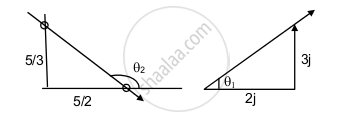
Since the directions of the field and the displacement are perpendicular to earth other, no work is done by the gravitational field when a particle is moved on the given line.
APPEARS IN
RELATED QUESTIONS
Write the answer of the question with reference to laws of gravitation.
State the universal law of gravitation.
If the moon attracts the earth, why does the earth not move towards the moon?
Choose the correct alternative:
Acceleration due to gravity is independent of mass of the earth/mass of the body.
Choose the correct answer from among the given ones:
For the problem 8.10, the direction of the gravitational intensity at an arbitrary point P is indicated by the arrow (i) d, (ii) e, (iii) f, (iv) g.
State two applications of universal law of gravitation.
State the universal law of gravitation. Name the scientist who gave this law.
Write the three laws given by Kepler. How did they help Newton to arrive at the inverse square law of gravity?
Inside a uniform spherical shell
(a) the gravitational potential is zero
(b) the gravitational field is zero
(c) the gravitational potential is same everywhere
(d) the gravitational field is same everywhere
Four particles having masses m, 2m, 3m and 4m are placed at the four corners of a square of edge a. Find the gravitational force acting on a particle of mass m placed at the centre.
Three equal masses m are placed at the three corners of an equilateral triangle of side a. Find the force exerted by this system on another particle of mass m placed at (a) the mid-point of a side, (b) at the centre of the triangle.
The mass of moon is about 0.012 times that of earth and its diameter is about 0.25 times that of earth. The value of G on the moon will be:
Explain the following:
People often shake the branches of a tree for getting down its fruits.
A ball is thrown vertically upwards. It goes to a height 20 m and then returns to the ground. Taking acceleration due to gravity g to be 10 ms-2 , find :
the total time of journey of the ball .
Is there a gravitational attraction between you and the book? Explain.
State Newton's law of gravitation. What is the difference between:
Gravity and gravitation
Solve the following problem.
Find the gravitational force between the Sun and the Earth.
Given Mass of the Sun = 1.99 × 1030 kg
Mass of the Earth = 5.98 × 1024 kg
The average distance between the Earth and the Sun = 1.5 × 10¹¹ m.
State Newton’s universal law of gravitation. Express it with the mathematical form of force of gravitation?
Six point masses of mass m each are at the vertices of a regular hexagon of side l. Calculate the force on any of the masses.
If the mass of one object is doubled and distance remains the same, the gravitational force will ______.
Ocean tides on Earth are mainly caused by ______.
