Advertisements
Advertisements
Question
Solve the following problem.
Find the gravitational force between the Sun and the Earth.
Given Mass of the Sun = 1.99 × 1030 kg
Mass of the Earth = 5.98 × 1024 kg
The average distance between the Earth and the Sun = 1.5 × 10¹¹ m.
Advertisements
Solution
Given: MS = 1.99 × 1030 kg, ME = 5.98 × 1024 kg, R = 1.5 × 10¹¹ m
To find: Gravitational force between the Sun and the Earth (F)
Formula: F = `("Gm"_1"m"_2)/"r"^2`
Calculation: As, we know, G = 6.67 × 10⁻¹¹ N m2/kg2
From formula,
F = `("GM"_"s""M"_"E")/"R"^2`
`= (6.67 xx 10^-11 xx 1.99 xx 10^30 xx 5.98 xx 10^24)/(1.5 xx 10^11)^2`
∴ F = `(6.67 xx 1.99 xx 5.98)/2.25 xx 10^21`
= antilog{(log(6.67) + log(1.99) + log(5.98) - log(2.25)} × 1021
= antilog{(0.8241) + (0.2989) + (0.7767) - (0.3522)} × 1021
= antilog{1.5475} × 1021
= 35.28 × 1021
= 3.5 × 10²² N
The gravitational force between the Sun and the Earth is = 3.5 × 10²² N.
APPEARS IN
RELATED QUESTIONS
Choose the correct alternative:
Acceleration due to gravity is independent of mass of the earth/mass of the body.
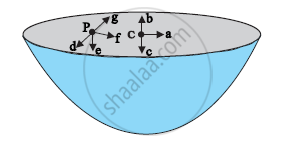
The gravitational intensity at the centre of a hemispherical shell of uniform mass density has the direction indicated by the arrow (see Fig 8.12) (i) a, (ii) b, (iii) c, (iv) 0.
A rocket is fired from the earth towards the sun. At what distance from the earth’s centre is the gravitational force on the rocket zero? Mass of the sun = 2 ×1030 kg, mass of the earth = 6 × 1024 kg. Neglect the effect of other planets etc. (orbital radius = 1.5 × 10¹¹ m).
At noon, the sun and the earth pull the objects on the earth's surface in opposite directions. At midnight, the sun and the earth pull these objects in same direction. Is the weight of an object, as measured by a spring balance on the earth's surface, more at midnight as compared to its weight at noon?
Three equal masses m are placed at the three corners of an equilateral triangle of side a. Find the force exerted by this system on another particle of mass m placed at (a) the mid-point of a side, (b) at the centre of the triangle.
Derive an expression for the gravitational field due to a uniform rod of length L and mass M at a point on its perpendicular bisector at a distance d from the centre.
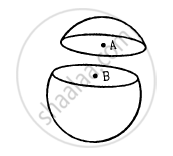
A thin spherical shell having uniform density is cut in two parts by a plane and kept separated as shown in the following figure. The point A is the centre of the plane section of the first part and B is the centre of the plane section of the second part. Show that the gravitational field at A due to the first part is equal in magnitude to the gravitational field at B due to the second part.
The gravitational field in a region is given by \[E = \left( 2 \overrightarrow{i} + 3 \overrightarrow{j} \right) N {kg}^{- 1}\] . Show that no work is done by the gravitational field when a particle is moved on the line 3y + 2x = 5.
[Hint : If a line y = mx + c makes angle θ with the X-axis, m = tan θ.]
The law of gravitation gives the gravitational force between :
Explain the following:
People often shake the branches of a tree for getting down its fruits.
A ball is thrown vertically upwards. It goes to a height 20 m and then returns to the ground. Taking acceleration due to gravity g to be 10 ms-2, find: the initial velocity of the ball.
How will the force of gravitation between two objects change if the distance between them is:
Made four times
Two equal and opposite forces acting at the same point on a stationary body. Will the body move? Give reason to explain your answer.
Explain why:
The atmosphere does not escape.
An apple falls towards the earth due to its gravitational force. The apple also attracts the earth with the same force. Why do we not see the earth rising towards the apple? Explain.
The gravitational force between two bodies is directly proportional to the product of the masses of those bodies and is ______ of the distance between them.
The value of universal gravitational constant (G) in the SI unit is ______.
State the universal law of gravitation and derive its mathematical expression.
Law of gravitation gives the gravitational force between
Particles of masses 2M, m and M are respectively at points A, B and C with AB = ½ (BC). m is much-much smaller than M and at time t = 0, they are all at rest (Figure). At subsequent times before any collision takes place ______.

The gravitational force between a hollow spherical shell (of radius R and uniform density) and a point mass is F. Show the nature of F vs r graph where r is the distance of the point from the centre of the hollow spherical shell of uniform density.
Give scientific reasons for the following:
Newton's gravitational law is the universal law of gravitation.
Answer the following questions in reference to the figure below:

- Which relation is shown in the figure?
- What will happen if the mass of one of the objects is doubled?
Observe the figure and answer the questions:

- State Newton's universal law of gravitation.
- If the distance between the two bodies is tripled, how will the gravitational force between them change?
- What will happen to gravitational force, if mass of one of the object is doubled?
If the distance between two objects is doubled, the gravitational force becomes ______.
Who measured the value of the Universal Gravitational Constant G using the Cavendish balance?
The gravitational force between two objects acts in which direction?
