Advertisements
Advertisements
Question
Four particles of equal masses M move along a circle of radius R under the action of their mutual gravitational attraction. Find the speed of each particle.
Advertisements
Solution
Assume that three particles are at points A, B and C on the circumference of a circle.
BC = CD = \[\sqrt{2}a\]
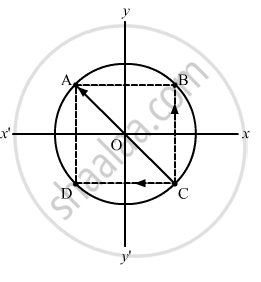
The force on the particle at C due to gravitational attraction of the particle at B is
\[\overrightarrow{F}_{CB} = \frac{G M^2}{2 R^2} \hat j\] .
The force on the particle at C due to gravitational attraction of the particle at D is
\[\overrightarrow{F}_{CD} = - \frac{G M^2}{2 R^2} \hat i\].
Now, force on the particle at C due to gravitational attraction of the particle at A is given by
\[\overrightarrow{F}_{CA} = - \frac{G M^2}{4 R^2}\cos 45 \hat i + \frac{G M^2}{4 R^2}\sin 45 \hat j\]
\[ \therefore \overrightarrow{F}_C = \overrightarrow{F}_{CA} + \overrightarrow{F}_{CB} + \overrightarrow{F}_{CD} \]
\[ = \frac{- G M^2}{4 R^2}\left( 2 + \frac{1}{\sqrt{2}} \right) \hat i + \frac{G M^2}{4 R^2}\left( 2 + \frac{1}{\sqrt{2}} \right) \hat j\]
So, the resultant gravitational force on C is \[F_C = \frac{G m^2}{4 R^2}\sqrt{2\sqrt{2} + 1}\]
Let v be the velocity with which the particle is moving.
Centripetal force on the particle is given by
\[F = \frac{m v^2}{R}\]
\[ \Rightarrow v = \sqrt{\frac{GM}{R}\left( \frac{2\sqrt{2} + 1}{4} \right)}\]
APPEARS IN
RELATED QUESTIONS
What is the magnitude of the gravitational force between the earth and a 1 kg object on its surface? (Mass of the earth is 6 × 1024 kg and radius of the earth is 6.4 × 10⁶ m).
If the moon attracts the earth, why does the earth not move towards the moon?
What happens to the force between two objects, if the mass of one object is doubled?
Can we apply Newton’s third law to the gravitational force ? Explain your answer.
State the universal law of gravitation. Name the scientist who gave this law.
Write the three laws given by Kepler. How did they help Newton to arrive at the inverse square law of gravity?
Can two particles be in equilibrium under the action of their mutual gravitational force? Can three particles be? Can one of the three particles be?
At noon, the sun and the earth pull the objects on the earth's surface in opposite directions. At midnight, the sun and the earth pull these objects in same direction. Is the weight of an object, as measured by a spring balance on the earth's surface, more at midnight as compared to its weight at noon?
A tunnel is dug along a chord of the earth at a perpendicular distance R/2 from the earth's centre. The wall of the tunnel may be assumed to be frictionless. Find the force exerted by the wall on a particle of mass m when it is at a distance x from the centre of the tunnel.
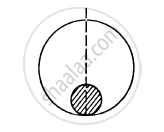
A solid sphere of mass m and radius r is placed inside a hollow thin spherical shell of mass M and radius R as shown in the following figure . A particle of mass m' is placed on the line joining the two centres at a distance x from the point of contact of the sphere and the shell. Find the magnitude of the resultant gravitational force on this particle due to the sphere and the shell if (a) r < x < 2r, (b) 2r < x < 2R and (c) x > 2R.
Who stated the law of gravitation?
Distinguish between gravity and gravitation
At what height above the earth's surface would the value of acceleration due to gravity be half of what it is on the surface? Take the radius of earth to be R.
What does a force do in the following case?
You pull the skin of your arm
Why does a ball moving on a table top eventually stops?
The ______ force is much weaker than other forces in nature.
Law of gravitation gives the gravitational force between
Four identical particles of equal masses 1 kg made to move along the circumference of a circle of radius 1 m under the action of their own mutual gravitational attraction. The speed of each particle will be ______.
If the distance between two objects is doubled, the gravitational force becomes ______.
