Advertisements
Advertisements
Question
A person sitting in a chair in a satellite feels weightless because
Options
the earth does not attract the objects in a satellite
the normal force by the chair on the person balances the earth's attraction
the normal force is zero
the person in satellite is not accelerated.
Advertisements
Solution
the normal force is zero
The gravitational pull on the satellite is used up in providing the necessary centripetal force required for its revolution around the earth. This means that there is no net force on the person sitting in a chair in the satellite. So, the normal reaction of the chair on the person is zero and he will feel weightless.
APPEARS IN
RELATED QUESTIONS
If the moon attracts the earth, why does the earth not move towards the moon?
Choose the correct alternative:
Acceleration due to gravity increases/decreases with increasing depth. (assume the earth to be a sphere of uniform density).
How will you ‘weigh the sun’, that is estimate its mass? The mean orbital radius of the earth around the sun is 1.5 × 10⁸ km.
Universal law of gravitation states that every object exerts a gravitational force of attraction on every other object. If this is true, why don’t we notice such forces ? Why don’t the two objects in a room move towards each other due to this force ?
At noon, the sun and the earth pull the objects on the earth's surface in opposite directions. At midnight, the sun and the earth pull these objects in same direction. Is the weight of an object, as measured by a spring balance on the earth's surface, more at midnight as compared to its weight at noon?
Four particles of equal masses M move along a circle of radius R under the action of their mutual gravitational attraction. Find the speed of each particle.
Distinguish between gravity and gravitation
What does a force do in the following case?
You pull the skin of your arm
What does a force do in the following case?
You twist a piece of rubber.
Name and state the action and reaction in the following case:
A book lying on a table.
Why does a ball moving on a table top eventually stops?
State the law of gravitation. Why is it called universal?
What is the difference between gravity and gravitation?
Mahendra and Virat are sitting at a distance of 1m from each other. Their masses are 75 kg and 80 kg respectively. What is the gravitational force between them? (G = 6.67 × 10⁻¹¹ Nm2/kg2)
State Newton’s universal law of gravitation. Express it with the mathematical form of force of gravitation?
Law of gravitation gives the gravitational force between
As observed from earth, the sun appears to move in an approximate circular orbit. For the motion of another planet like mercury as observed from earth, this would ______.
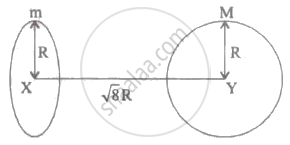
Find the gravitational force of attraction between the ring and sphere as shown in the diagram, where the plane of the ring is perpendicular to the line joining the centres. If `sqrt8` R is the distance between the centres of a ring (of mass 'm')and a sphere (mass 'M') where both have equal radius 'R'.
If the distance between two objects is doubled, the gravitational force becomes ______.
