Advertisements
Advertisements
Question
Mahendra and Virat are sitting at a distance of 1m from each other. Their masses are 75 kg and 80 kg respectively. What is the gravitational force between them? (G = 6.67 × 10⁻¹¹ Nm2/kg2)
Advertisements
Solution
Given:
Distance (r) = 1 m, mass (m1) = 75 kg, mass (m2) = 80 kg, gravitational constant (G) = 6.67 × 10⁻¹¹ Nm2/kg2
To find:
Gravitational force (F)
F = `("Gm"_1"m"_2)/"r"^2` ...[From formula]
F = `(6.67 xx 10^-11 xx 75 xx 80)/1^2`
∴ F = 4.002 × 10⁻⁷ N
The gravitational force between Mahendra and Virat is 4.002 × 10⁻⁷ N.
APPEARS IN
RELATED QUESTIONS
Calculate the force of gravitation between the earth and the Sun, given that the mass of the earth = 6 × 1024 kg and of the Sun = 2 × 1030 kg. The average distance between the two is 1.5 × 10¹¹ m.
Answer the following:
You can shield a charge from electrical forces by putting it inside a hollow conductor. Can you shield a body from the gravitational influence of nearby matter by putting it inside a hollow sphere or by some other means?
A rocket is fired from the earth towards the sun. At what distance from the earth’s centre is the gravitational force on the rocket zero? Mass of the sun = 2 ×1030 kg, mass of the earth = 6 × 1024 kg. Neglect the effect of other planets etc. (orbital radius = 1.5 × 10¹¹ m).
Which of the Kepler’s laws of planetary motion led Newton to establish the inverse-square rule for gravitational force between two bodies ?
The weight of an object is more at the poles than at the equator. Is it beneficial to purchase goods at equator and sell them at the pole? Does it matter whether a spring balance is used or an equal-beam balance is used?
Let V and E be the gravitational potential and gravitational field at a distance r from the centre of a uniform spherical shell. Consider the following two statements :
(A) The plot of V against r is discontinuous.
(B) The plot of E against r is discontinuous.
Two spherical balls of mass 10 kg each are placed 10 cm apart. Find the gravitational force of attraction between them.
A tunnel is dug along a diameter of the earth. Find the force on a particle of mass m placed in the tunnel at a distance x from the centre.
Who stated the law of gravitation?
All objects in the universe attract each other along the line joining their________.
A ball is thrown up with a speed of 4.9 ms-1.
Calculate the maximum height it would gain before it begins to fall.
What does a force do in the following case?
You catch a kicked ball.
Name and state the action and reaction in the following case:
A book lying on a table.
Two equal and opposite forces acting at the same point on a stationary body. Will the body move? Give reason to explain your answer.
Gravity is another kind of ________. It exerts all through the ________. The Sun's gravity keeps the ___________ in their orbits. Gravity can only be felt with very large ________.
The gravitational force between a hollow spherical shell (of radius R and uniform density) and a point mass is F. Show the nature of F vs r graph where r is the distance of the point from the centre of the hollow spherical shell of uniform density.
Complete the chart below.
| F(N) | M1(kg) | M2(kg) | D(m) |
| (a) | 50 | 84 | 02 |
| 16 × 109 | 1.63 × 10²² | (b) | 34 |
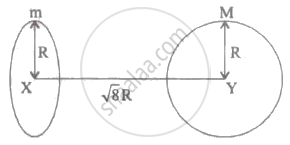
Find the gravitational force of attraction between the ring and sphere as shown in the diagram, where the plane of the ring is perpendicular to the line joining the centres. If `sqrt8` R is the distance between the centres of a ring (of mass 'm')and a sphere (mass 'M') where both have equal radius 'R'.
Observe the figure and answer the questions:

- State Newton's universal law of gravitation.
- If the distance between the two bodies is tripled, how will the gravitational force between them change?
- What will happen to gravitational force, if mass of one of the object is doubled?
Ocean tides on Earth are mainly caused by ______.
