Advertisements
Advertisements
Question
Can two particles be in equilibrium under the action of their mutual gravitational force? Can three particles be? Can one of the three particles be?
Advertisements
Solution
A particle will be in equilibrium when the net force acting on it is equal to zero. Two particles under the action of their mutual gravitational force will be in equilibrium when they revolve around a common point under the influence of their mutual gravitational force of attraction. In this case, the gravitational pull is used up in providing the necessary centripetal force. Hence, the net force on the particles is zero and they are in equilibrium. This is also true for a three particle system.
APPEARS IN
RELATED QUESTIONS
Universal law of gravitation states that every object exerts a gravitational force of attraction on every other object. If this is true, why don’t we notice such forces ? Why don’t the two objects in a room move towards each other due to this force ?
Write the three laws given by Kepler. How did they help Newton to arrive at the inverse square law of gravity?
The weight of an object is more at the poles than at the equator. Is it beneficial to purchase goods at equator and sell them at the pole? Does it matter whether a spring balance is used or an equal-beam balance is used?
A body is suspended from a spring balance kept in a satellite. The reading of the balance is W1 when the satellite goes in an orbit of radius R and is W2 when it goes in an orbit of radius 2 −R.
Four particles having masses m, 2m, 3m and 4m are placed at the four corners of a square of edge a. Find the gravitational force acting on a particle of mass m placed at the centre.
Three equal masses m are placed at the three corners of an equilateral triangle of side a. Find the force exerted by this system on another particle of mass m placed at (a) the mid-point of a side, (b) at the centre of the triangle.
Two small bodies of masses 10 kg and 20 kg are kept a distance 1.0 m apart and released. Assuming that only mutual gravitational forces are acting, find the speeds of the particles when the separation decreases to 0.5 m.
A tunnel is dug along a chord of the earth at a perpendicular distance R/2 from the earth's centre. The wall of the tunnel may be assumed to be frictionless. Find the force exerted by the wall on a particle of mass m when it is at a distance x from the centre of the tunnel.
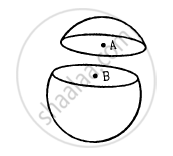
A thin spherical shell having uniform density is cut in two parts by a plane and kept separated as shown in the following figure. The point A is the centre of the plane section of the first part and B is the centre of the plane section of the second part. Show that the gravitational field at A due to the first part is equal in magnitude to the gravitational field at B due to the second part.
Define one Newton. How much maximum acceleration can it produce in a mass of 1 kg?
How will the force of gravitation between two objects change if the distance between them is:
Made four times
How will the force of gravitation between two objects change if the distance between them is:
Almost zero
Is the law of gravitation applicable in case of the sun and the moon?
A ball is thrown up with a speed of 4.9 ms-1.
Calculate the time it takes to reach this height.
What does a force do in the following case?
You twist a piece of rubber.
Name and state the action and reaction in the following case:
A book lying on a table.
Two equal and opposite forces acting at the same point on a stationary body. Will the body move? Give reason to explain your answer.
State Newton's law of gravitation. What is the difference between:
Gravity and gravitation
As observed from earth, the sun appears to move in an approximate circular orbit. For the motion of another planet like mercury as observed from earth, this would ______.
Complete the chart below.
| F(N) | M1(kg) | M2(kg) | D(m) |
| (a) | 50 | 84 | 02 |
| 16 × 109 | 1.63 × 10²² | (b) | 34 |
