Advertisements
Advertisements
प्रश्न
Can two particles be in equilibrium under the action of their mutual gravitational force? Can three particles be? Can one of the three particles be?
Advertisements
उत्तर
A particle will be in equilibrium when the net force acting on it is equal to zero. Two particles under the action of their mutual gravitational force will be in equilibrium when they revolve around a common point under the influence of their mutual gravitational force of attraction. In this case, the gravitational pull is used up in providing the necessary centripetal force. Hence, the net force on the particles is zero and they are in equilibrium. This is also true for a three particle system.
APPEARS IN
संबंधित प्रश्न
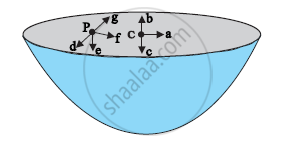
The gravitational intensity at the centre of a hemispherical shell of uniform mass density has the direction indicated by the arrow (see Fig 8.12) (i) a, (ii) b, (iii) c, (iv) 0.
A rocket is fired from the earth towards the sun. At what distance from the earth’s centre is the gravitational force on the rocket zero? Mass of the sun = 2 ×1030 kg, mass of the earth = 6 × 1024 kg. Neglect the effect of other planets etc. (orbital radius = 1.5 × 10¹¹ m).
The weight of an object is more at the poles than at the equator. Is it beneficial to purchase goods at equator and sell them at the pole? Does it matter whether a spring balance is used or an equal-beam balance is used?
Let V and E represent the gravitational potential and field at a distance r from the centre of a uniform solid sphere. Consider the two statements:
(A) the plot of V against r is discontinuous.
(B) The plot of E against r is discontinuous.
A body is suspended from a spring balance kept in a satellite. The reading of the balance is W1 when the satellite goes in an orbit of radius R and is W2 when it goes in an orbit of radius 2 −R.
Two small bodies of masses 10 kg and 20 kg are kept a distance 1.0 m apart and released. Assuming that only mutual gravitational forces are acting, find the speeds of the particles when the separation decreases to 0.5 m.
Explain the following:
People often shake the branches of a tree for getting down its fruits.
Write an expression for the gravitational force of attraction between two bodies of masses m1 and m2 separated by a distance r.
How will the force of gravitation between two objects change if the distance between them is:
Almost zero
Name and state the action and reaction in the following case:
Hammering a nail.
Explain the difference between g and G.
Mahendra and Virat are sitting at a distance of 1m from each other. Their masses are 75 kg and 80 kg respectively. What is the gravitational force between them? (G = 6.67 × 10⁻¹¹ Nm2/kg2)
State the universal law of gravitation and derive its mathematical expression.
Shown are several curves (Figure). Explain with reason, which ones amongst them can be possible trajectories traced by a projectile (neglect air friction).
Two particles of equal mass 'm' go around a circle of radius R under the action of their mutual gravitational attraction. The speed of each particle with respect to its centre of mass is ______.
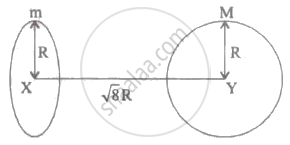
Find the gravitational force of attraction between the ring and sphere as shown in the diagram, where the plane of the ring is perpendicular to the line joining the centres. If `sqrt8` R is the distance between the centres of a ring (of mass 'm')and a sphere (mass 'M') where both have equal radius 'R'.
A hollow spherical shell of uniform density exerts what gravitational force on a point mass placed inside it?
For an object outside a uniform solid sphere, from where is the sphere's mass considered to act?
