Advertisements
Advertisements
प्रश्न
Solve the following problem.
Calculate the acceleration due to gravity at a height of 300 km from the surface of the Earth. (M = 5.98 × 1024 kg, R = 6400 km).
Advertisements
उत्तर
Given: h = 300 km = 0.3 × 10⁶ m, M = 5.98 × 1024 kg, R = 6400 km = 6.4 × 10⁶ m, G = 6.67 × 10⁻¹¹ Nm2/kg2
To find: Acceleration due to gravity at height (gh)
Formula: `"g"_"h" = "GM"/("R + h")^2`
Calculation:
From formula,
`"g"_"h" = (6.67 xx 10^-11 xx 5.98 xx 10^24)/([(6.4 xx 10^6) + (0.3 xx 10^6)]^2)`
`= (6.67 xx 5.98 xx 10^13)/((6.7)^2 xx 10^12)`
= antilog{log(6.67) + log(5.98) - 2log(6.7)} × 10
= antilog{0.8241 + 0.7767 - 2(0.8261)} × 10
= antilog{1.6008 - 1.6522} × 10
= antilog{`bar1`.9486} × 10
= 0.8884 × 10
= 8.884 m/s2
Acceleration due to gravity at 300 km will be 8.884 m/s2.
APPEARS IN
संबंधित प्रश्न
What happens to the force between two objects, if the mass of one object is doubled?
What is the importance of the universal law of gravitation?
Choose the correct alternative:
Acceleration due to gravity increases/decreases with increasing depth. (assume the earth to be a sphere of uniform density).
Choose the correct alternative:
Acceleration due to gravity is independent of mass of the earth/mass of the body.
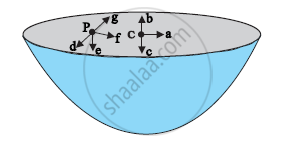
The gravitational intensity at the centre of a hemispherical shell of uniform mass density has the direction indicated by the arrow (see Fig 8.12) (i) a, (ii) b, (iii) c, (iv) 0.
State two applications of universal law of gravitation.
State the universal law of gravitation. Name the scientist who gave this law.
Let V and E be the gravitational potential and gravitational field at a distance r from the centre of a uniform spherical shell. Consider the following two statements :
(A) The plot of V against r is discontinuous.
(B) The plot of E against r is discontinuous.
Inside a uniform spherical shell
(a) the gravitational potential is zero
(b) the gravitational field is zero
(c) the gravitational potential is same everywhere
(d) the gravitational field is same everywhere
Which of the following quantities remain constant in a planetary motion (consider elliptical orbits) as seen from the sun?
Two spherical balls of mass 10 kg each are placed 10 cm apart. Find the gravitational force of attraction between them.
Two concentric spherical shells have masses M1, M2 and radii R1, R2 (R1 < R2). What is the force exerted by this system on a particle of mass m1 if it is placed at a distance (R1+ R2)/2 from the centre?
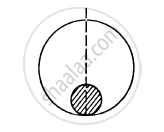
A solid sphere of mass m and radius r is placed inside a hollow thin spherical shell of mass M and radius R as shown in the following figure . A particle of mass m' is placed on the line joining the two centres at a distance x from the point of contact of the sphere and the shell. Find the magnitude of the resultant gravitational force on this particle due to the sphere and the shell if (a) r < x < 2r, (b) 2r < x < 2R and (c) x > 2R.
State whether the gravitational force between two masses is attractive or repulsive ?
A ball is thrown up with a speed of 4.9 ms-1.
Calculate the maximum height it would gain before it begins to fall.
At what height above the earth's surface would the value of acceleration due to gravity be half of what it is on the surface? Take the radius of earth to be R.
What does a force do in the following case?
You pull the skin of your arm
You can change the direction in which an object is moving by___________.
Name and state the action and reaction in the following case:
A book lying on a table.
State the law of gravitation. Why is it called universal?
Is there a gravitational attraction between you and the book? Explain.
Answer the following question.
What are the dimensions of the universal gravitational constant?
To project the rockets which of the following principle(s) is /(are) required?
As observed from earth, the sun appears to move in an approximate circular orbit. For the motion of another planet like mercury as observed from earth, this would ______.
Six point masses of mass m each are at the vertices of a regular hexagon of side l. Calculate the force on any of the masses.
Newton's universal law of gravitation applies to ______.
If the distance between two objects is doubled, the gravitational force becomes ______.
Who measured the value of the Universal Gravitational Constant G using the Cavendish balance?
A hollow spherical shell of uniform density exerts what gravitational force on a point mass placed inside it?
