Advertisements
Advertisements
प्रश्न
A person brings a mass of 1 kg from infinity to a point A. Initially the mass was at rest but it moves at a speed of 2 m s −1 as it reaches A. The work done by the person on the mass is −3 J. The potential at A is
विकल्प
−3 J kg−1
−2 J kg−1
−5 J kg−4
none of these.
Advertisements
उत्तर
−5 J kg−4
The work done by the person is equal to the kinetic energy and the potential energy of the mass of 1 kg at point A.
Let VA be the potential at point A.
\[\text { Now }, W = \frac{1}{2}m v^2 + \left( P . E . \right)_A \]
\[ \Rightarrow W = \frac{1}{2}m v^2 + V_A \times m\]
\[ \Rightarrow - 3 = \frac{1}{2} \times 1 \times (2 )^2 + V_A \times 1\]
\[ \Rightarrow V_A = - 5 J/Kg\]
APPEARS IN
संबंधित प्रश्न
What is the importance of the universal law of gravitation?
State Kepler’s law which is represented by the relation r3 ∝ T2.
Two small bodies of masses 10 kg and 20 kg are kept a distance 1.0 m apart and released. Assuming that only mutual gravitational forces are acting, find the speeds of the particles when the separation decreases to 0.5 m.
A semicircular wire has a length L and mass M. A particle of mass m is placed at the centre of the circle. Find the gravitational attraction on the particle due to the wire.
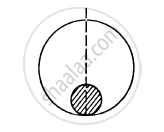
A solid sphere of mass m and radius r is placed inside a hollow thin spherical shell of mass M and radius R as shown in the following figure . A particle of mass m' is placed on the line joining the two centres at a distance x from the point of contact of the sphere and the shell. Find the magnitude of the resultant gravitational force on this particle due to the sphere and the shell if (a) r < x < 2r, (b) 2r < x < 2R and (c) x > 2R.
The mass of moon is about 0.012 times that of earth and its diameter is about 0.25 times that of earth. The value of G on the moon will be:
Write an expression for the gravitational force of attraction between two bodies of masses m1 and m2 separated by a distance r.
Multiple Choice Question. Select the correct option.
The mass of earth is 6 × 1024 kg and radius of earth is 6.4 × 10⁶ m. The magnitude of force between the mass of 1 kg and the earth is:
The acceleration produced by a force in an object is directly proportional to the applied _________ And inversely proportional to the _________ Of the object.
How will the force of gravitation between two objects change if the distance between them is:
Halved
How will the force of gravitation between two objects change if the distance between them is:
Doubled
A force can produce ________, In an object at rest. It can __________ an object and change its __________ of motion.
What does a force do in the following case?
You apply brakes to a running car.
Name and state the action and reaction in the following case:
Hammering a nail.
The ______ force is much weaker than other forces in nature.
Particles of masses 2M, m and M are respectively at points A, B and C with AB = ½ (BC). m is much-much smaller than M and at time t = 0, they are all at rest (Figure). At subsequent times before any collision takes place ______.

The gravitational force between a hollow spherical shell (of radius R and uniform density) and a point mass is F. Show the nature of F vs r graph where r is the distance of the point from the centre of the hollow spherical shell of uniform density.
Write the answer of the question with reference to laws of gravitation.
Write the value of the universal gravitational constant.
Newton's universal law of gravitation applies to ______.
