Advertisements
Advertisements
प्रश्न
State and explain Kepler's laws of planetary motion. Draw diagrams to illustrate these laws.
Advertisements
उत्तर
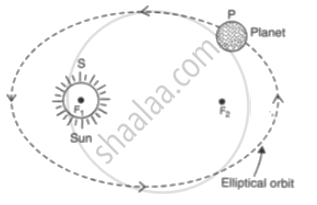
- Kepler's first law: The planets move in elliptical orbits around the sun, with the sun at one of the two foci. of the elliptical orbit. This law means that the orbit of a planet around the sun is an ellipse and not an exact circle. An elliptical path has two foci, and the sun is at one of the two foci of the elliptical path.
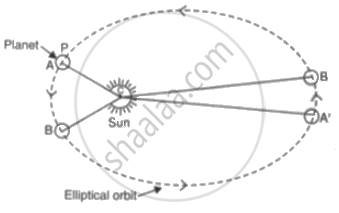
- Kepler's Second law: Each planet revolves around the sun in such a way that the line joining the planet to the sun sweeps over equal areas in equal intervals of time. This means that a planet does not move with constant speed around the sun. The speed is greater when the planet is nearer the sun and less when the planet is farther away from the sun.
- Kepler's Third Law: The cube of the mean distance of a planet from the sun is directly proportional to the square of time it takes to move around the sun. r3 ∝ T2.
APPEARS IN
संबंधित प्रश्न
What is the importance of the universal law of gravitation?
Choose the correct alternative:
Acceleration due to gravity is independent of mass of the earth/mass of the body.
Choose the correct answer from among the given ones:
For the problem 8.10, the direction of the gravitational intensity at an arbitrary point P is indicated by the arrow (i) d, (ii) e, (iii) f, (iv) g.
Derive an expression for the gravitational field due to a uniform rod of length L and mass M at a point on its perpendicular bisector at a distance d from the centre.
The gravitational field in a region is given by \[E = \left( 2 \overrightarrow{i} + 3 \overrightarrow{j} \right) N {kg}^{- 1}\] . Show that no work is done by the gravitational field when a particle is moved on the line 3y + 2x = 5.
[Hint : If a line y = mx + c makes angle θ with the X-axis, m = tan θ.]
All objects in the universe attract each other along the line joining their________.
Why does a ball moving on a table top eventually stops?
Answer the following question.
What are the dimensions of the universal gravitational constant?
The value of universal gravitational constant (G) in the SI unit is ______.
Two particles of equal mass 'm' go around a circle of radius R under the action of their mutual gravitational attraction. The speed of each particle with respect to its centre of mass is ______.
