Advertisements
Advertisements
प्रश्न
Three equal masses m are placed at the three corners of an equilateral triangle of side a. Find the force exerted by this system on another particle of mass m placed at (a) the mid-point of a side, (b) at the centre of the triangle.
Advertisements
उत्तर
(a) Consider that mass 'm' is placed at the midpoint O of side AB of equilateral triangle ABC.

AO = BO = \[\frac{a}{2}\]
Then \[\overrightarrow{F}_{OA} = \frac{4G m^2}{a^2}\] along OA
Also, \[\overrightarrow{F}_{OB} = \frac{4 G m^2}{a^2}\]along OB
OC = \[\frac{\sqrt{3}a}{2}\]
\[\overrightarrow{F}_{OC} = \frac{4 G m^2}{\left\{ \left( 3 \right) a^2 \right\}} = \frac{4G m^2}{3 a^2}\] along OC
The net force on the particle at O is \[\overrightarrow{F} = \overrightarrow{F}_{OA} + \overrightarrow{F}_{OB} + \overrightarrow{F}_{OC}\]
Since equal and opposite forces cancel each other, we have :
\[\overrightarrow{F} = \overrightarrow{F}_{OC} = \frac{4 G m^2}{\left\{ \left( 3 \right) a^2 \right\}} = \frac{4G m^2}{3 a^2}\] along OC.
(b) If the particle placed at O (centroid)

All the forces are equal in magnitude but their directions are different as shown in the figure.
Equal and opposite forces along OM and ON cancel each other.
i.e., \[F\cos30^\circ= F\cos30^\circ\]
∴ Resultant force \[= F - 2F\sin30 = 0\]
APPEARS IN
संबंधित प्रश्न
Calculate the force of gravitation between the earth and the Sun, given that the mass of the earth = 6 × 1024 kg and of the Sun = 2 × 1030 kg. The average distance between the two is 1.5 × 10¹¹ m.
Choose the correct alternative:
Acceleration due to gravity is independent of mass of the earth/mass of the body.
State Kepler’s law which is represented by the relation r3 ∝ T2.
A person brings a mass of 1 kg from infinity to a point A. Initially the mass was at rest but it moves at a speed of 2 m s −1 as it reaches A. The work done by the person on the mass is −3 J. The potential at A is
Which of the following quantities remain constant in a planetary motion (consider elliptical orbits) as seen from the sun?
Three uniform spheres each having a mass M and radius a are kept in such a way that each touches the other two. Find the magnitude of the gravitational force on any of the spheres due to the other two.
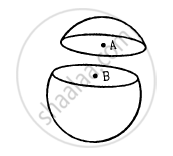
A thin spherical shell having uniform density is cut in two parts by a plane and kept separated as shown in the following figure. The point A is the centre of the plane section of the first part and B is the centre of the plane section of the second part. Show that the gravitational field at A due to the first part is equal in magnitude to the gravitational field at B due to the second part.
The law of gravitation gives the gravitational force between :
A ball is thrown vertically upwards. It goes to a height 20 m and then returns to the ground. Taking acceleration due to gravity g to be 10 ms-2, find: the initial velocity of the ball.
How will the force of gravitation between two objects change if the distance between them is:
Infinite
A ball is thrown up with a speed of 4.9 ms-1.
Calculate the maximum height it would gain before it begins to fall.
A ball is thrown up with a speed of 4.9 ms-1.
Calculate the time it takes to reach this height.
At what height above the earth's surface would the value of acceleration due to gravity be half of what it is on the surface? Take the radius of earth to be R.
What does a force do in the following case?
You twist a piece of rubber.
Does the force of the earth's gravitation affect the motion of the moon? Explain your answer with reasons.
The distance-time values for an object moving along straight line are given below:
| Time (s) | Distance (m) |
| 0 | 0 |
| 1 | 1 |
| 2 | 8 |
| 3 | 27 |
The force of gravitation between two bodies of mass 1 kg each separated by a distance of 1 m in vacuum is ____________.
Two particles of equal mass 'm' go around a circle of radius R under the action of their mutual gravitational attraction. The speed of each particle with respect to its centre of mass is ______.
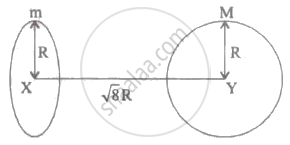
Find the gravitational force of attraction between the ring and sphere as shown in the diagram, where the plane of the ring is perpendicular to the line joining the centres. If `sqrt8` R is the distance between the centres of a ring (of mass 'm')and a sphere (mass 'M') where both have equal radius 'R'.
If three equal masses m are placed at the three vertices of an equilateral triangle of side 1/m then what force acts on a particle of mass 2m placed at the centroid?
