Advertisements
Advertisements
प्रश्न
The _______ force is much weaker than other forces in nature.
विकल्प
gravitational
electromagnetic
nuclear force
intermolecular
Advertisements
उत्तर
The gravitational force is much weaker than other forces in nature.
APPEARS IN
संबंधित प्रश्न
Write the answer of the question with reference to laws of gravitation.
State the universal law of gravitation.
The earth and the moon are attracted to each other by gravitational force. Does the earth attract the moon with a force that is greater or smaller or the same as the force with which the moon attracts the earth? Why?
Choose the correct alternative:
Acceleration due to gravity increases/decreases with increasing altitude.
How will you ‘weigh the sun’, that is estimate its mass? The mean orbital radius of the earth around the sun is 1.5 × 10⁸ km.
Which of the Kepler’s laws of planetary motion led Newton to establish the inverse-square rule for gravitational force between two bodies ?
Can we apply Newton’s third law to the gravitational force ? Explain your answer.
State two applications of universal law of gravitation.
The weight of an object is more at the poles than at the equator. Is it beneficial to purchase goods at equator and sell them at the pole? Does it matter whether a spring balance is used or an equal-beam balance is used?
A particle of mass 100 g is kept on the surface of a uniform sphere of mass 10 kg and radius 10 cm. Find the work to be done against the gravitational force between them to take the particle away from the sphere.
Explain the following:
People often shake the branches of a tree for getting down its fruits.
Define one Newton. How much maximum acceleration can it produce in a mass of 1 kg?
How will the force of gravitation between two objects change if the distance between them is:
Doubled
A ball is thrown up with a speed of 4.9 ms-1.
Prove that the time of ascent is equal to the time of descent.
Name and state the action and reaction in the following case:
Hammering a nail.
What is the difference between gravity and gravitation?
To project the rockets which of the following principle(s) is /(are) required?
Give the applications of universal law gravitation.
Three uniform spheres, each having mass m and radius r, are kept in such a way that each touches the other two. The magnitude of the gravitational force on any sphere due to the other two is
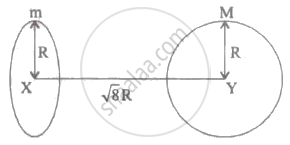
Find the gravitational force of attraction between the ring and sphere as shown in the diagram, where the plane of the ring is perpendicular to the line joining the centres. If `sqrt8` R is the distance between the centres of a ring (of mass 'm')and a sphere (mass 'M') where both have equal radius 'R'.
Who measured the value of the Universal Gravitational Constant G using the Cavendish balance?
