Advertisements
Advertisements
प्रश्न
The value of universal gravitational constant (G) in the SI unit is ______.
विकल्प
6.673 × 10⁻¹¹ Nm2/kg2
6.673 × 10¹¹ Nm/kg
9.673 × 10⁻¹¹ Nm/kg
9.673 × 10⁻¹¹ Nm2/kg2
Advertisements
उत्तर
The value of universal gravitational constant (G) in the SI unit is 6.673 × 10⁻¹¹ Nm2/kg2.
Explanation:
This constant appears in Newton's law of gravitation and determines the strength of the gravitational force between two masses.
संबंधित प्रश्न
What happens to the force between two objects, if the mass of one object is doubled?
Answer the following:
You can shield a charge from electrical forces by putting it inside a hollow conductor. Can you shield a body from the gravitational influence of nearby matter by putting it inside a hollow sphere or by some other means?
If you compare the gravitational force on the Earth due to the Sun to that due to the Moon, you would find that the Sun’s pull is greater than the Moon’s pull. (You can check this yourself using the data available in the succeeding exercises). However, the tidal effect of the Moon’s pull is greater than the tidal effect of Sun. Why?
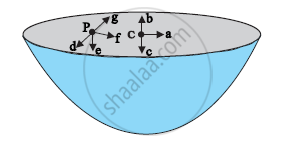
The gravitational intensity at the centre of a hemispherical shell of uniform mass density has the direction indicated by the arrow (see Fig 8.12) (i) a, (ii) b, (iii) c, (iv) 0.
Which of the Kepler’s laws of planetary motion led Newton to establish the inverse-square rule for gravitational force between two bodies ?
State two applications of universal law of gravitation.
Universal law of gravitation states that every object exerts a gravitational force of attraction on every other object. If this is true, why don’t we notice such forces ? Why don’t the two objects in a room move towards each other due to this force ?
Write the three laws given by Kepler. How did they help Newton to arrive at the inverse square law of gravity?
A person brings a mass of 1 kg from infinity to a point A. Initially the mass was at rest but it moves at a speed of 2 m s −1 as it reaches A. The work done by the person on the mass is −3 J. The potential at A is
Two spherical balls of mass 10 kg each are placed 10 cm apart. Find the gravitational force of attraction between them.
A semicircular wire has a length L and mass M. A particle of mass m is placed at the centre of the circle. Find the gravitational attraction on the particle due to the wire.
The force of attraction between any two material objects is called __________.
Name and state the action and reaction in the following case:
Hammering a nail.
Explain why:
The atmosphere does not escape.
The distance-time values for an object moving along straight line are given below:
| Time (s) | Distance (m) |
| 0 | 0 |
| 1 | 1 |
| 2 | 8 |
| 3 | 27 |
Show that gravity decreases at higher altitudes.
The gravitational force between a hollow spherical shell (of radius R and uniform density) and a point mass is F. Show the nature of F vs r graph where r is the distance of the point from the centre of the hollow spherical shell of uniform density.
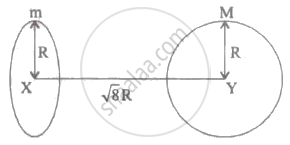
Find the gravitational force of attraction between the ring and sphere as shown in the diagram, where the plane of the ring is perpendicular to the line joining the centres. If `sqrt8` R is the distance between the centres of a ring (of mass 'm')and a sphere (mass 'M') where both have equal radius 'R'.
For an object outside a uniform solid sphere, from where is the sphere's mass considered to act?
The gravitational force between two objects acts in which direction?
