Advertisements
Advertisements
प्रश्न
A ball is thrown up with a speed of 4.9 ms-1.
Prove that the time of ascent is equal to the time of descent.
Advertisements
उत्तर
For highest point initial velocity is zero
Acceleration due to gravity is = 9.8 ms-2.
Final velocity at ground is v
V2 - 0 = 2 X9.8 X 1.125
V = 4.9 ms-1.
Time taken to reach ground from highest point
V = u + at
4.9 = 0 + 9.8 t
T = 4.9/9.8 = 0.5 sec.
So time of ascent is equal to time descent.
APPEARS IN
संबंधित प्रश्न
The earth and the moon are attracted to each other by gravitational force. Does the earth attract the moon with a force that is greater or smaller or the same as the force with which the moon attracts the earth? Why?
The gravitational intensity at the centre of a hemispherical shell of uniform mass density has the direction indicated by the arrow (see Fig 8.12) (i) a, (ii) b, (iii) c, (iv) 0.
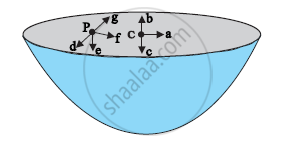
Write the three laws given by Kepler. How did they help Newton to arrive at the inverse square law of gravity?
Four particles having masses m, 2m, 3m and 4m are placed at the four corners of a square of edge a. Find the gravitational force acting on a particle of mass m placed at the centre.
Multiple Choice Question. Select the correct option.
The mass of earth is 6 × 1024 kg and radius of earth is 6.4 × 10⁶ m. The magnitude of force between the mass of 1 kg and the earth is:
A ball is thrown up with a speed of 4.9 ms-1.
Calculate the time it takes to reach this height.
State Newton's law of gravitation. What is the difference between:
g and G?
Law of gravitation gives the gravitational force between
The gravitational force between a hollow spherical shell (of radius R and uniform density) and a point mass is F. Show the nature of F vs r graph where r is the distance of the point from the centre of the hollow spherical shell of uniform density.
If the distance between two objects is doubled, the gravitational force becomes ______.
