Advertisements
Advertisements
प्रश्न
Four particles having masses m, 2m, 3m and 4m are placed at the four corners of a square of edge a. Find the gravitational force acting on a particle of mass m placed at the centre.
Advertisements
उत्तर
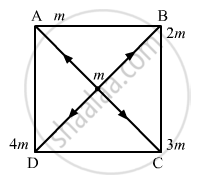
\[\text { Force due to the particle at A }, \overrightarrow{F}_{OA} = \frac{G \times m \times m}{{OA}^2}\]
\[\text { Let OA } = r\]
\[ \therefore \overrightarrow{F}_{OA} = \frac{G \times m \times m}{r^2} \]
\[\text { Here }, r = \sqrt{\left( \frac{a}{2} \right)^2 + \left( \frac{a}{2} \right)^2} = \frac{a}{\sqrt{2}}\]
\[\text { Force due to the particle at B }, \overrightarrow{F}_{OB} = \frac{G \times m \times 2m}{r^2}\]
\[\text { Force due to the particle at C }, \overrightarrow{F}_{OC} = \frac{G \times m \times 3m}{r^2}\]
\[\text { Force due to the particle at D }, \overrightarrow{F}_{OD} = \frac{G \times m \times 4m}{r^2}\]
\[\text { Now, resultant force }= \overrightarrow{F}_{OA} + \overrightarrow{F}_{OB} + \overrightarrow{F}_{OC} + \overrightarrow{F}_{OD} \]
\[ = \frac{2Gmm}{a^2}\left[ - \frac{\overrightarrow{i}}{\sqrt{2}} + \frac{\overrightarrow{j}}{\sqrt{2}} \right] + \frac{4Gmm}{a^2}\left[ \frac{\overrightarrow{i}}{\sqrt{2}} + \frac{\overrightarrow{j}}{\sqrt{2}} \right]\]
\[ = \frac{6Gmm}{a^2}\left[ \frac{\overrightarrow{i}}{\sqrt{2}} - \frac{\vec{j}}{\sqrt{2}} \right] + \frac{8Gmm}{a^2}\left[ \frac{- \overrightarrow{i}}{\sqrt{2}} - \frac{- \overrightarrow{j}}{\sqrt{2}} \right]\]
\[ \therefore F = \frac{4\sqrt{4}G m^2}{a^2} \stackrel\frown {j}\]
APPEARS IN
संबंधित प्रश्न
Write the formula to find the magnitude of the gravitational force between the earth and an object on the surface of the earth.
Choose the correct alternative:
Acceleration due to gravity increases/decreases with increasing depth. (assume the earth to be a sphere of uniform density).
Suppose the gravitational potential due to a small system is k/r2 at a distance r from it. What will be the gravitational field? Can you think of any such system? What happens if there were negative masses?
Two spherical balls of mass 10 kg each are placed 10 cm apart. Find the gravitational force of attraction between them.
How will the force of gravitation between two objects change if the distance between them is:
Infinite
A ball is thrown up with a speed of 4.9 ms-1.
Calculate the time it takes to reach this height.
Name and state the action and reaction in the following case:
Hammering a nail.
Gravity is another kind of ________. It exerts all through the ________. The Sun's gravity keeps the ___________ in their orbits. Gravity can only be felt with very large ________.
Show that gravity decreases at higher altitudes.
State Newton’s universal law of gravitation. Express it with the mathematical form of force of gravitation?
The force of gravitation between two bodies of mass 1 kg each separated by a distance of 1 m in vacuum is ____________.
Choose the wrong option.
If the law of gravitation, instead of being inverse-square law, becomes an inverse-cube law- ______.
- planets will not have elliptic orbits.
- circular orbits of planets is not possible.
- projectile motion of a stone thrown by hand on the surface of the earth will be approximately parabolic.
- there will be no gravitational force inside a spherical shell of uniform density.
Molecules in air in the atmosphere are attracted by gravitational force of the earth. Explain why all of them do not fall into the earth just like an apple falling from a tree.
How is the gravitational force between two point masses affected when they are dipped in water keeping the separation between them the same?
Shown are several curves (Figure). Explain with reason, which ones amongst them can be possible trajectories traced by a projectile (neglect air friction).
Ocean tides on Earth are mainly caused by ______.
The acceleration of the Moon towards the Earth is approximately ______.
If the distance between two objects is doubled, the gravitational force becomes ______.
