Advertisements
Advertisements
प्रश्न
Six point masses of mass m each are at the vertices of a regular hexagon of side l. Calculate the force on any of the masses.
Advertisements
उत्तर
Consider the diagram below, in which six point masses are placed at six verticles A, B, C, D, E and F.
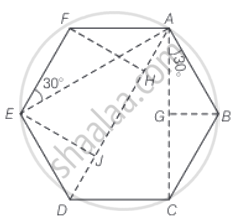
AC = AG + GC = 2AG
= `2l cos 30^circ`
= `2l sqrt(3)/2`
= `sqrt(3)l`
= AE
AD = AH + HJ + JD
= `l sin 30^circ + l + l sin 30^circ`
= `2l`
Force on mass m at A due to mass m at B is, `f_1 = (Gmm)/l^2` = along AB.
Force on mass m at A due to mass m at C is, `f_2 = (Gm xx m)/(sqrt(3)l)^2 = (Gm^2)/(3l^2)` along AC. ......[∵ AC = `sqrt(2)`l]
Force on mass m at A due to mass m at D is, `f_3 = (Gm xx m)/(2l)^2 = (Gm^2)/(4l^2)` along AD ......[∵ AD = 2l]
Force on mass m at A due to mass m at E is, `f_4 = (Gm xx m)/(sqrt(3)l)^2 = (Gm^2)/(3l^2)` along AE.
Force on mass m at A due to mass m at F is, `f_5 = (Gm xx m)/l^2 = (Gm^2)/l^2`along AF.
Resultant force due to `f_1` and `f_5` is `F_1 = sqrt(f_1^2 + f_5^2 + 2f_1f_5 cos 120^circ) = (Gm^2)/l^2` along AD. ...........[∵ Angle between `f_1` and `f_2` = 120°]
Resultant force due to `f_2` and `f_4` is `F_2 = sqrt(f_2^2 + f_4^2 + 2f_2f_4 cos 60^circ) = (sqrt(3)Gm^2)/(3l^2) = (Gm^2)/(sqrt(3)l^2)`along AD.
So, net force along AD = `F_1 + F_2 + F_3`
= `(Gm^2)/l^2 + (Gm^2)/(sqrt(3)l^2) + (Gm^2)/(4l^2)`
= `(Gm^2)/l^2 (1 + 1/sqrt(3) + 1/4)`
APPEARS IN
संबंधित प्रश्न
Write the answer of the question with reference to laws of gravitation.
State the universal law of gravitation.
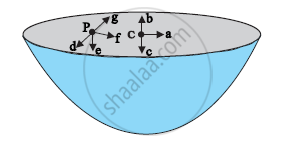
The gravitational intensity at the centre of a hemispherical shell of uniform mass density has the direction indicated by the arrow (see Fig 8.12) (i) a, (ii) b, (iii) c, (iv) 0.
State Kepler’s law which is represented by the relation r3 ∝ T2.
State the universal law of gravitation. Name the scientist who gave this law.
Three equal masses m are placed at the three corners of an equilateral triangle of side a. Find the force exerted by this system on another particle of mass m placed at (a) the mid-point of a side, (b) at the centre of the triangle.
A tunnel is dug along a diameter of the earth. Find the force on a particle of mass m placed in the tunnel at a distance x from the centre.
Define one Newton. How much maximum acceleration can it produce in a mass of 1 kg?
At what height above the earth's surface would the value of acceleration due to gravity be half of what it is on the surface? Take the radius of earth to be R.
Name and state the action and reaction in the following case:
A book lying on a table.
State Newton's law of gravitation. What is the difference between:
g and G?
Answer the following question.
What are the dimensions of the universal gravitational constant?
Solve the following problem.
Find the gravitational force between the Sun and the Earth.
Given Mass of the Sun = 1.99 × 1030 kg
Mass of the Earth = 5.98 × 1024 kg
The average distance between the Earth and the Sun = 1.5 × 10¹¹ m.
The force of gravitation between two bodies of mass 1 kg each separated by a distance of 1 m in vacuum is ____________.
If the law of gravitation, instead of being inverse-square law, becomes an inverse-cube law- ______.
- planets will not have elliptic orbits.
- circular orbits of planets is not possible.
- projectile motion of a stone thrown by hand on the surface of the earth will be approximately parabolic.
- there will be no gravitational force inside a spherical shell of uniform density.
Molecules in air in the atmosphere are attracted by gravitational force of the earth. Explain why all of them do not fall into the earth just like an apple falling from a tree.
A hollow spherical shell of uniform density exerts what gravitational force on a point mass placed inside it?
For an object outside a uniform solid sphere, from where is the sphere's mass considered to act?
The gravitational force between two objects acts in which direction?
