Advertisements
Advertisements
प्रश्न
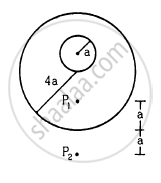
A uniform metal sphere of radius a and mass M is surrounded by a thin uniform spherical shell of equal mass and radius 4a (In the following figure). The centre of the shell falls on the surface of the inner sphere. Find the gravitational field at the points P1 and P2 shown in the figure.
Advertisements
उत्तर
At point P1, the gravitational field due to the sphere and the shell is given by
F \[= \frac{GM}{\left( 3a + a \right)^2} + 0 = \frac{GM}{16 a^2}\]
At point P2, the gravitational field due to the sphere and the shell is given by
\[F = \frac{GM}{\left( a + 4a + a \right)^2} + \frac{GM}{\left( 4a + a \right)^2}\]
\[ \Rightarrow F = \frac{GM}{36 a^2} + \frac{GM}{25 a^2}\]
\[ \Rightarrow F = \frac{GM}{a^2}\left( \frac{1}{36} + \frac{1}{25} \right)\]
\[ \Rightarrow F = \frac{GM}{a^2}\left( \frac{25 + 36}{900} \right)\]
\[ \Rightarrow F = \left( \frac{61}{900} \right)\frac{GM}{a^2}\]
APPEARS IN
संबंधित प्रश्न
Write the formula to find the magnitude of the gravitational force between the earth and an object on the surface of the earth.
What happens to the force between two objects, if the mass of one object is doubled?
What is the importance of the universal law of gravitation?
Choose the correct answer from among the given ones:
For the problem 8.10, the direction of the gravitational intensity at an arbitrary point P is indicated by the arrow (i) d, (ii) e, (iii) f, (iv) g.
Can we apply Newton’s third law to the gravitational force ? Explain your answer.
Suppose the gravitational potential due to a small system is k/r2 at a distance r from it. What will be the gravitational field? Can you think of any such system? What happens if there were negative masses?
Consider a planet moving in an elliptical orbit round the sun. The work done on the planet by the gravitational force of the sun
(a) is zero in any small part of the orbit
(b) is zero in some parts of the orbit
(c) is zero in one complete revolution
(d) is zero in no part of the motion.
Which of the following quantities remain constant in a planetary motion (consider elliptical orbits) as seen from the sun?
Four particles having masses m, 2m, 3m and 4m are placed at the four corners of a square of edge a. Find the gravitational force acting on a particle of mass m placed at the centre.
A tunnel is dug along a diameter of the earth. Find the force on a particle of mass m placed in the tunnel at a distance x from the centre.
All objects in the universe attract each other along the line joining their________.
A ball is thrown up with a speed of 4.9 ms-1.
Calculate the time it takes to reach this height.
At what height above the earth's surface would the value of acceleration due to gravity be half of what it is on the surface? Take the radius of earth to be R.
Two equal and opposite forces acting at the same point on a stationary body. Will the body move? Give reason to explain your answer.
Gravity is another kind of ________. It exerts all through the ________. The Sun's gravity keeps the ___________ in their orbits. Gravity can only be felt with very large ________.
Answer the following question.
State Newton’s law of gravitation and express it in vector form.
The value of universal gravitational constant (G) in the SI unit is ______.
State the universal law of gravitation and derive its mathematical expression.
If three equal masses m are placed at the three vertices of an equilateral triangle of side 1/m then what force acts on a particle of mass 2m placed at the centroid?
