Advertisements
Advertisements
प्रश्न
The value of universal gravitational constant (G) in the SI unit is ______.
विकल्प
6.673 × 10⁻¹¹ Nm2/kg2
6.673 × 10¹¹ Nm/kg
9.673 × 10⁻¹¹ Nm/kg
9.673 × 10⁻¹¹ Nm2/kg2
Advertisements
उत्तर
The value of universal gravitational constant (G) in the SI unit is 6.673 × 10⁻¹¹ Nm2/kg2.
Explanation:
This constant appears in Newton's law of gravitation and determines the strength of the gravitational force between two masses.
संबंधित प्रश्न
What happens to the force between two objects, if the masses of both objects are doubled?
Calculate the force of gravitation between the earth and the Sun, given that the mass of the earth = 6 × 1024 kg and of the Sun = 2 × 1030 kg. The average distance between the two is 1.5 × 10¹¹ m.
Universal law of gravitation states that every object exerts a gravitational force of attraction on every other object. If this is true, why don’t we notice such forces ? Why don’t the two objects in a room move towards each other due to this force ?
Let V and E be the gravitational potential and gravitational field at a distance r from the centre of a uniform spherical shell. Consider the following two statements :
(A) The plot of V against r is discontinuous.
(B) The plot of E against r is discontinuous.
Let V and E represent the gravitational potential and field at a distance r from the centre of a uniform solid sphere. Consider the two statements:
(A) the plot of V against r is discontinuous.
(B) The plot of E against r is discontinuous.
Two spherical balls of mass 10 kg each are placed 10 cm apart. Find the gravitational force of attraction between them.
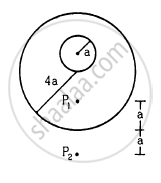
A uniform metal sphere of radius a and mass M is surrounded by a thin uniform spherical shell of equal mass and radius 4a (In the following figure). The centre of the shell falls on the surface of the inner sphere. Find the gravitational field at the points P1 and P2 shown in the figure.
State whether the gravitational force between two masses is attractive or repulsive ?
How will the force of gravitation between two objects change if the distance between them is:
Almost zero
A ball is thrown up with a speed of 4.9 ms-1.
Calculate the maximum height it would gain before it begins to fall.
What is meant by the equation :
`g= Gxxm/r^2`
where the symbols have their usual meanings.
What does a force do in the following case?
You catch a kicked ball.
The gravitational force between a hollow spherical shell (of radius R and uniform density) and a point mass is F. Show the nature of F vs r graph where r is the distance of the point from the centre of the hollow spherical shell of uniform density.
Shown are several curves (Figure). Explain with reason, which ones amongst them can be possible trajectories traced by a projectile (neglect air friction).
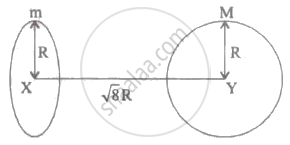
Find the gravitational force of attraction between the ring and sphere as shown in the diagram, where the plane of the ring is perpendicular to the line joining the centres. If `sqrt8` R is the distance between the centres of a ring (of mass 'm')and a sphere (mass 'M') where both have equal radius 'R'.
The Superposition Principle states that the net gravitational force on an object is ______.
The acceleration of the Moon towards the Earth is approximately ______.
Who measured the value of the Universal Gravitational Constant G using the Cavendish balance?
The gravitational force between two objects acts in which direction?
