Advertisements
Advertisements
प्रश्न
State Kepler’s law which is represented by the relation r3 ∝ T2.
Advertisements
उत्तर
Kepler’s law of periods states that: The cube of the mean distance of a planet from the sun is directly proportional to the square of the time it takes to move around the sun.
APPEARS IN
संबंधित प्रश्न
If you compare the gravitational force on the Earth due to the Sun to that due to the Moon, you would find that the Sun’s pull is greater than the Moon’s pull. (You can check this yourself using the data available in the succeeding exercises). However, the tidal effect of the Moon’s pull is greater than the tidal effect of Sun. Why?
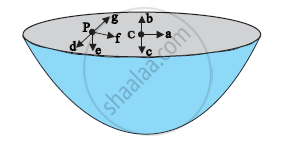
The gravitational intensity at the centre of a hemispherical shell of uniform mass density has the direction indicated by the arrow (see Fig 8.12) (i) a, (ii) b, (iii) c, (iv) 0.
Suppose the gravitational potential due to a small system is k/r2 at a distance r from it. What will be the gravitational field? Can you think of any such system? What happens if there were negative masses?
A body is suspended from a spring balance kept in a satellite. The reading of the balance is W1 when the satellite goes in an orbit of radius R and is W2 when it goes in an orbit of radius 2 −R.
How will the force of gravitation between two objects change if the distance between them is:
Made four times
What is the difference between gravity and gravitation?
Gravity is another kind of ________. It exerts all through the ________. The Sun's gravity keeps the ___________ in their orbits. Gravity can only be felt with very large ________.
Is there a gravitational attraction between you and the book? Explain.
Does the force of the earth's gravitation affect the motion of the moon? Explain your answer with reasons.
If three equal masses m are placed at the three vertices of an equilateral triangle of side 1/m then what force acts on a particle of mass 2m placed at the centroid?
