Advertisements
Advertisements
प्रश्न
What do you mean by a gravitational constant?
Advertisements
उत्तर
- From Newton’s law of gravitation,
F = G`("m"_1"m"_2)/"r"^2`
where, G = constant called universal gravitational constant. Its value is 6.67 × 10⁻¹¹ N m2/kg2. - G = `"Fr"^2/("m"_1"m"_2)`
If m1 = m2 = 1 kg, r = 1 m then F = G.
Hence, the universal gravitational constant is the force of gravitation between two particles of unit mass separated by unit distance.
APPEARS IN
संबंधित प्रश्न
If you compare the gravitational force on the Earth due to the Sun to that due to the Moon, you would find that the Sun’s pull is greater than the Moon’s pull. (You can check this yourself using the data available in the succeeding exercises). However, the tidal effect of the Moon’s pull is greater than the tidal effect of Sun. Why?
Choose the correct alternative:
Acceleration due to gravity increases/decreases with increasing altitude.
Choose the correct alternative:
Acceleration due to gravity increases/decreases with increasing depth. (assume the earth to be a sphere of uniform density).
Choose the correct alternative:
Acceleration due to gravity is independent of mass of the earth/mass of the body.
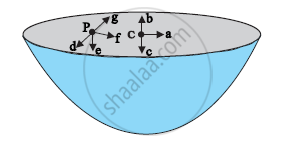
The gravitational intensity at the centre of a hemispherical shell of uniform mass density has the direction indicated by the arrow (see Fig 8.12) (i) a, (ii) b, (iii) c, (iv) 0.
At noon, the sun and the earth pull the objects on the earth's surface in opposite directions. At midnight, the sun and the earth pull these objects in same direction. Is the weight of an object, as measured by a spring balance on the earth's surface, more at midnight as compared to its weight at noon?
Let V and E be the gravitational potential and gravitational field at a distance r from the centre of a uniform spherical shell. Consider the following two statements :
(A) The plot of V against r is discontinuous.
(B) The plot of E against r is discontinuous.
A body is suspended from a spring balance kept in a satellite. The reading of the balance is W1 when the satellite goes in an orbit of radius R and is W2 when it goes in an orbit of radius 2 −R.
A tunnel is dug along a diameter of the earth. Find the force on a particle of mass m placed in the tunnel at a distance x from the centre.
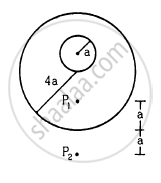
A uniform metal sphere of radius a and mass M is surrounded by a thin uniform spherical shell of equal mass and radius 4a (In the following figure). The centre of the shell falls on the surface of the inner sphere. Find the gravitational field at the points P1 and P2 shown in the figure.
A ball is thrown vertically upwards. It goes to a height 20 m and then returns to the ground. Taking acceleration due to gravity g to be 10 ms-2, find: the initial velocity of the ball.
How will the force of gravitation between two objects change if the distance between them is:
Doubled
Why don't you feel the force of attraction between your friend sitting close to you and yourself?
Where will you weigh more: at the moon's surface or at the earth's surface?
Explain why:
The atmosphere does not escape.
Is there a gravitational attraction between you and the book? Explain.
Show that gravity decreases at higher altitudes.
Answer the following question.
What are the dimensions of the universal gravitational constant?
The gravitational force between two bodies is directly proportional to the product of the masses of those bodies and is ______ of the distance between them.
The value of universal gravitational constant (G) in the SI unit is ______.
Mahendra and Virat are sitting at a distance of 1m from each other. Their masses are 75 kg and 80 kg respectively. What is the gravitational force between them? (G = 6.67 × 10⁻¹¹ Nm2/kg2)
For the weight of body of mass 5 kg to be zero on equator of the earth, angular velocity of the earth must be (The radius of earth = 6400 km, acceleration due to gravity = 10 m/s2).
Three uniform spheres, each having mass m and radius r, are kept in such a way that each touches the other two. The magnitude of the gravitational force on any sphere due to the other two is
If the law of gravitation, instead of being inverse-square law, becomes an inverse-cube law- ______.
- planets will not have elliptic orbits.
- circular orbits of planets is not possible.
- projectile motion of a stone thrown by hand on the surface of the earth will be approximately parabolic.
- there will be no gravitational force inside a spherical shell of uniform density.
Answer the following questions in reference to the figure below:

- Which relation is shown in the figure?
- What will happen if the mass of one of the objects is doubled?
Two particles of equal mass 'm' go around a circle of radius R under the action of their mutual gravitational attraction. The speed of each particle with respect to its centre of mass is ______.
Ocean tides on Earth are mainly caused by ______.
If the distance between two objects is doubled, the gravitational force becomes ______.
Newton formulated the Universal Law of Gravitation by combining the ideas of which two scientists with his own Laws of Motion?
