Advertisements
Advertisements
प्रश्न
A particle of mass 100 g is kept on the surface of a uniform sphere of mass 10 kg and radius 10 cm. Find the work to be done against the gravitational force between them to take the particle away from the sphere.
Advertisements
उत्तर
The work done against the gravitational force to take the particle away from the sphere to infinity is equal to the difference between the potential energy of the particle at infinity and potential energy of the particle at the surface of the sphere.
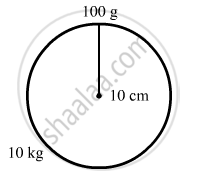
\[\therefore W = 0 - \left( - \frac{G \times 10 \times 0 . 1}{1 \times 0 . 1} \right)\]
\[ = \frac{6 . 67 \times {10}^{- 11} \times 1}{1 \times 0 . 1}\]
\[ = 6 . 67 \times {10}^{- 10} J\]
APPEARS IN
संबंधित प्रश्न
At noon, the sun and the earth pull the objects on the earth's surface in opposite directions. At midnight, the sun and the earth pull these objects in same direction. Is the weight of an object, as measured by a spring balance on the earth's surface, more at midnight as compared to its weight at noon?
Let V and E be the gravitational potential and gravitational field at a distance r from the centre of a uniform spherical shell. Consider the following two statements :
(A) The plot of V against r is discontinuous.
(B) The plot of E against r is discontinuous.
Let V and E represent the gravitational potential and field at a distance r from the centre of a uniform solid sphere. Consider the two statements:
(A) the plot of V against r is discontinuous.
(B) The plot of E against r is discontinuous.
A person sitting in a chair in a satellite feels weightless because
Two spherical balls of mass 10 kg each are placed 10 cm apart. Find the gravitational force of attraction between them.
A tunnel is dug along a chord of the earth at a perpendicular distance R/2 from the earth's centre. The wall of the tunnel may be assumed to be frictionless. Find the force exerted by the wall on a particle of mass m when it is at a distance x from the centre of the tunnel.
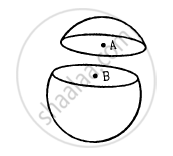
A thin spherical shell having uniform density is cut in two parts by a plane and kept separated as shown in the following figure. The point A is the centre of the plane section of the first part and B is the centre of the plane section of the second part. Show that the gravitational field at A due to the first part is equal in magnitude to the gravitational field at B due to the second part.
Is the law of gravitation applicable in case of the sun and the moon?
What does a force do in the following case?
You pull the skin of your arm
What does a force do in the following case?
You apply brakes to a running car.
Name and state the action and reaction in the following case:
A book lying on a table.
Gravity is another kind of ________. It exerts all through the ________. The Sun's gravity keeps the ___________ in their orbits. Gravity can only be felt with very large ________.
The force of gravitation between two bodies of mass 1 kg each separated by a distance of 1 m in vacuum is ____________.
Molecules in air in the atmosphere are attracted by gravitational force of the earth. Explain why all of them do not fall into the earth just like an apple falling from a tree.
We can shield a charge from electric fields by putting it inside a hollow conductor. Can we shield a body from the gravitational influence of nearby matter by putting it inside a hollow sphere or by some other means?
Write the answer of the question with reference to laws of gravitation.
Write the value of the universal gravitational constant.
Find the gravitational force of attraction between the ring and sphere as shown in the diagram, where the plane of the ring is perpendicular to the line joining the centres. If `sqrt8` R is the distance between the centres of a ring (of mass 'm')and a sphere (mass 'M') where both have equal radius 'R'.
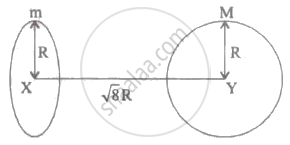
Observe the figure and answer the questions:

- State Newton's universal law of gravitation.
- If the distance between the two bodies is tripled, how will the gravitational force between them change?
- What will happen to gravitational force, if mass of one of the object is doubled?
If the mass of one object is doubled and distance remains the same, the gravitational force will ______.
The acceleration of the Moon towards the Earth is approximately ______.
