Advertisements
Advertisements
Question
A person brings a mass of 1 kg from infinity to a point A. Initially the mass was at rest but it moves at a speed of 2 m s −1 as it reaches A. The work done by the person on the mass is −3 J. The potential at A is
Options
−3 J kg−1
−2 J kg−1
−5 J kg−4
none of these.
Advertisements
Solution
−5 J kg−4
The work done by the person is equal to the kinetic energy and the potential energy of the mass of 1 kg at point A.
Let VA be the potential at point A.
\[\text { Now }, W = \frac{1}{2}m v^2 + \left( P . E . \right)_A \]
\[ \Rightarrow W = \frac{1}{2}m v^2 + V_A \times m\]
\[ \Rightarrow - 3 = \frac{1}{2} \times 1 \times (2 )^2 + V_A \times 1\]
\[ \Rightarrow V_A = - 5 J/Kg\]
APPEARS IN
RELATED QUESTIONS
The earth and the moon are attracted to each other by gravitational force. Does the earth attract the moon with a force that is greater or smaller or the same as the force with which the moon attracts the earth? Why?
Choose the correct answer from among the given ones:
For the problem 8.10, the direction of the gravitational intensity at an arbitrary point P is indicated by the arrow (i) d, (ii) e, (iii) f, (iv) g.
Universal law of gravitation states that every object exerts a gravitational force of attraction on every other object. If this is true, why don’t we notice such forces ? Why don’t the two objects in a room move towards each other due to this force ?
Let V and E represent the gravitational potential and field at a distance r from the centre of a uniform solid sphere. Consider the two statements:
(A) the plot of V against r is discontinuous.
(B) The plot of E against r is discontinuous.
Which of the following quantities remain constant in a planetary motion (consider elliptical orbits) as seen from the sun?
Derive an expression for the gravitational field due to a uniform rod of length L and mass M at a point on its perpendicular bisector at a distance d from the centre.
Two concentric spherical shells have masses M1, M2 and radii R1, R2 (R1 < R2). What is the force exerted by this system on a particle of mass m1 if it is placed at a distance (R1+ R2)/2 from the centre?
A tunnel is dug along a diameter of the earth. Find the force on a particle of mass m placed in the tunnel at a distance x from the centre.
A solid sphere of mass m and radius r is placed inside a hollow thin spherical shell of mass M and radius R as shown in the following figure . A particle of mass m' is placed on the line joining the two centres at a distance x from the point of contact of the sphere and the shell. Find the magnitude of the resultant gravitational force on this particle due to the sphere and the shell if (a) r < x < 2r, (b) 2r < x < 2R and (c) x > 2R.
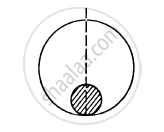
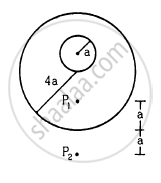
A uniform metal sphere of radius a and mass M is surrounded by a thin uniform spherical shell of equal mass and radius 4a (In the following figure). The centre of the shell falls on the surface of the inner sphere. Find the gravitational field at the points P1 and P2 shown in the figure.
A particle of mass 100 g is kept on the surface of a uniform sphere of mass 10 kg and radius 10 cm. Find the work to be done against the gravitational force between them to take the particle away from the sphere.
How will the force of gravitation between two objects change if the distance between them is:
Doubled
A force can produce ________, In an object at rest. It can __________ an object and change its __________ of motion.
Gravity is another kind of ________. It exerts all through the ________. The Sun's gravity keeps the ___________ in their orbits. Gravity can only be felt with very large ________.
The ______ force is much weaker than other forces in nature.
Molecules in air in the atmosphere are attracted by gravitational force of the earth. Explain why all of them do not fall into the earth just like an apple falling from a tree.
Give scientific reasons for the following:
Newton's gravitational law is the universal law of gravitation.
The Superposition Principle states that the net gravitational force on an object is ______.
A hollow spherical shell of uniform density exerts what gravitational force on a point mass placed inside it?
