Advertisements
Advertisements
Question
The ______ force is much weaker than other forces in nature.
Options
gravitational
electromagnetic
nuclear force
intermolecular
Advertisements
Solution
The gravitational force is much weaker than other forces in nature.
Explanation:
- Gravity is far weaker than electromagnetic and nuclear forces at atomic and molecular scales.
- However, because mass is always positive and bodies like planets and stars are huge, gravity controls astronomical motion.
APPEARS IN
RELATED QUESTIONS
If the moon attracts the earth, why does the earth not move towards the moon?
Choose the correct alternative:
Acceleration due to gravity increases/decreases with increasing altitude.
How will you ‘weigh the sun’, that is estimate its mass? The mean orbital radius of the earth around the sun is 1.5 × 10⁸ km.
Two concentric spherical shells have masses M1, M2 and radii R1, R2 (R1 < R2). What is the force exerted by this system on a particle of mass m1 if it is placed at a distance (R1+ R2)/2 from the centre?
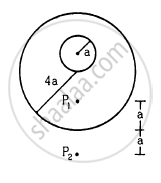
A uniform metal sphere of radius a and mass M is surrounded by a thin uniform spherical shell of equal mass and radius 4a (In the following figure). The centre of the shell falls on the surface of the inner sphere. Find the gravitational field at the points P1 and P2 shown in the figure.
Define one Newton. How much maximum acceleration can it produce in a mass of 1 kg?
A ball is thrown up with a speed of 4.9 ms-1.
Calculate the maximum height it would gain before it begins to fall.
What is the difference between gravity and gravitation?
Does the force of the earth's gravitation affect the motion of the moon? Explain your answer with reasons.
Show that gravity decreases at higher altitudes.
Solve the following problem.
Find the gravitational force between the Sun and the Earth.
Given Mass of the Sun = 1.99 × 1030 kg
Mass of the Earth = 5.98 × 1024 kg
The average distance between the Earth and the Sun = 1.5 × 10¹¹ m.
The force of gravitation between two bodies of mass 1 kg each separated by a distance of 1 m in vacuum is ____________.
As observed from earth, the sun appears to move in an approximate circular orbit. For the motion of another planet like mercury as observed from earth, this would ______.
The gravitational force between a hollow spherical shell (of radius R and uniform density) and a point mass is F. Show the nature of F vs r graph where r is the distance of the point from the centre of the hollow spherical shell of uniform density.
Give scientific reasons for the following:
Newton's gravitational law is the universal law of gravitation.
Who measured the value of the Universal Gravitational Constant G using the Cavendish balance?
For an object outside a uniform solid sphere, from where is the sphere's mass considered to act?
Newton formulated the Universal Law of Gravitation by combining the ideas of which two scientists with his own Laws of Motion?
