Advertisements
Advertisements
Question
Can we apply Newton’s third law to the gravitational force ? Explain your answer.
Advertisements
Solution
Yes, according to Newton's third law of motion, “to every action, there is an equal and opposite reaction”. Now, we apply this concept to the gravitational attraction between the sun and the earth. The sun exerts a gravitational force on the earth, and thus the earth also exerts a gravitational force on the sun. Thus, they are balanced in their orbits and the earth revolves around the sun.
APPEARS IN
RELATED QUESTIONS
Choose the correct alternative:
Acceleration due to gravity increases/decreases with increasing altitude.
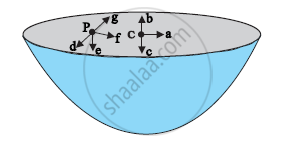
The gravitational intensity at the centre of a hemispherical shell of uniform mass density has the direction indicated by the arrow (see Fig 8.12) (i) a, (ii) b, (iii) c, (iv) 0.
A body is suspended from a spring balance kept in a satellite. The reading of the balance is W1 when the satellite goes in an orbit of radius R and is W2 when it goes in an orbit of radius 2 −R.
Derive an expression for the gravitational field due to a uniform rod of length L and mass M at a point on its perpendicular bisector at a distance d from the centre.
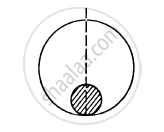
A solid sphere of mass m and radius r is placed inside a hollow thin spherical shell of mass M and radius R as shown in the following figure . A particle of mass m' is placed on the line joining the two centres at a distance x from the point of contact of the sphere and the shell. Find the magnitude of the resultant gravitational force on this particle due to the sphere and the shell if (a) r < x < 2r, (b) 2r < x < 2R and (c) x > 2R.
The law of gravitation gives the gravitational force between :
Where will you weigh more: at the centre of the earth or at the surface of the earth?
Gravity is another kind of ________. It exerts all through the ________. The Sun's gravity keeps the ___________ in their orbits. Gravity can only be felt with very large ________.
Does the force of the earth's gravitation affect the motion of the moon? Explain your answer with reasons.
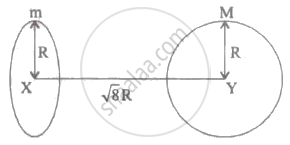
Find the gravitational force of attraction between the ring and sphere as shown in the diagram, where the plane of the ring is perpendicular to the line joining the centres. If `sqrt8` R is the distance between the centres of a ring (of mass 'm')and a sphere (mass 'M') where both have equal radius 'R'.