Advertisements
Advertisements
प्रश्न
Can we apply Newton’s third law to the gravitational force ? Explain your answer.
Advertisements
उत्तर
Yes, according to Newton's third law of motion, “to every action, there is an equal and opposite reaction”. Now, we apply this concept to the gravitational attraction between the sun and the earth. The sun exerts a gravitational force on the earth, and thus the earth also exerts a gravitational force on the sun. Thus, they are balanced in their orbits and the earth revolves around the sun.
APPEARS IN
संबंधित प्रश्न
What is the importance of the universal law of gravitation?
Answer the following:
You can shield a charge from electrical forces by putting it inside a hollow conductor. Can you shield a body from the gravitational influence of nearby matter by putting it inside a hollow sphere or by some other means?
The force of attraction between any two material objects is called __________.
Explain why:
The atmosphere does not escape.
Three uniform spheres, each having mass m and radius r, are kept in such a way that each touches the other two. The magnitude of the gravitational force on any sphere due to the other two is
Six point masses of mass m each are at the vertices of a regular hexagon of side l. Calculate the force on any of the masses.
Write the answer of the question with reference to laws of gravitation.
Write the value of the universal gravitational constant.
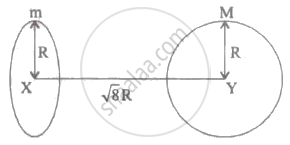
Find the gravitational force of attraction between the ring and sphere as shown in the diagram, where the plane of the ring is perpendicular to the line joining the centres. If `sqrt8` R is the distance between the centres of a ring (of mass 'm')and a sphere (mass 'M') where both have equal radius 'R'.
If the mass of one object is doubled and distance remains the same, the gravitational force will ______.
Who measured the value of the Universal Gravitational Constant G using the Cavendish balance?
