Advertisements
Advertisements
प्रश्न
The force of attraction between any two material objects is called __________.
Advertisements
उत्तर
The force of attraction between any two material objects is called FORCE OF GRAVITATION.
APPEARS IN
संबंधित प्रश्न
Let V and E represent the gravitational potential and field at a distance r from the centre of a uniform solid sphere. Consider the two statements:
(A) the plot of V against r is discontinuous.
(B) The plot of E against r is discontinuous.
Inside a uniform spherical shell
(a) the gravitational potential is zero
(b) the gravitational field is zero
(c) the gravitational potential is same everywhere
(d) the gravitational field is same everywhere
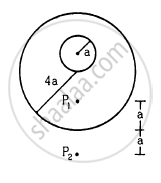
A uniform metal sphere of radius a and mass M is surrounded by a thin uniform spherical shell of equal mass and radius 4a (In the following figure). The centre of the shell falls on the surface of the inner sphere. Find the gravitational field at the points P1 and P2 shown in the figure.
The law of gravitation gives the gravitational force between :
Explain the following:
People often shake the branches of a tree for getting down its fruits.
Where will you weigh more: at the centre of the earth or at the surface of the earth?
Explain why:
The atmosphere does not escape.
Solve the following problem.
Find the gravitational force between the Sun and the Earth.
Given Mass of the Sun = 1.99 × 1030 kg
Mass of the Earth = 5.98 × 1024 kg
The average distance between the Earth and the Sun = 1.5 × 10¹¹ m.
To project the rockets which of the following principle(s) is /(are) required?
Shown are several curves (Figure). Explain with reason, which ones amongst them can be possible trajectories traced by a projectile (neglect air friction).
