Advertisements
Advertisements
Question
Is there any meaning of “weight of the earth”?
Advertisements
Solution
The weight of a body is always due to its gravitational attraction to earth. As law of gravitational attraction is universal so it applies to any two bodies (earth and sun as well). So we can define the weight of earth with respect to a body of mass comparable to or greater than earth’s, due to the gravitational attraction between earth and that body. But practically nobody on earth has mass comparable to earth, so the weight of earth will be a meaningless concept with respect to the earth frame.
APPEARS IN
RELATED QUESTIONS
Assuming the earth to be a sphere of uniform mass density, how much would a body weigh half way down to the centre of the earth if it weighed 250 N on the surface?
If heavier bodies are attracted more strongly by the earth, why don't they fall faster than the lighter bodies?
The acceleration of moon with respect to earth is 0⋅0027 m s−2 and the acceleration of an apple falling on earth' surface is about 10 m s−2. Assume that the radius of the moon is one fourth of the earth's radius. If the moon is stopped for an instant and then released, it will fall towards the earth. The initial acceleration of the moon towards the earth will be
The acceleration of the moon just before it strikes the earth in the previous question is
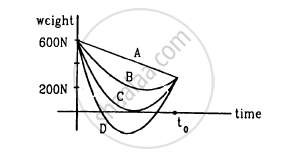
Suppose, the acceleration due to gravity at the earth's surface is 10 m s−2 and at the surface of Mars it is 4⋅0 m s−2. A 60 kg passenger goes from the earth to the Mars in a spaceship moving with a constant velocity. Neglect all other objects in the sky. Which part of the following figure best represents the weight (net gravitational force) of the passenger as a function of time?
If the acceleration due to gravity at the surface of the earth is g, the work done in slowly lifting a body of mass m from the earth's surface to a height R equal to the radius of the earth is
Find the acceleration due to gravity of the moon at a point 1000 km above the moon's surface. The mass of the moon is 7.4 × 10²² kg and its radius is 1740 km.
Find the height over the Earth's surface at which the weight of a body becomes half of its value at the surface.
What is the acceleration due to gravity on the top of Mount Everest? Mount Everest is the highest mountain peak of the world at the height of 8848 m. The value at sea level is 9.80 m s−2.
Find the acceleration due to gravity in a mine of depth 640 m if the value at the surface is 9.800 m s−2. The radius of the earth is 6400 km.
A particle is fired vertically upward from earth's surface and it goes up to a maximum height of 6400 km. Find the initial speed of particle.
If the acceleration due to gravity becomes 4 times its original value, then escape speed ____________.
Explain the variation of g with latitude.
One can easily weigh the earth by calculating the mass of the earth by using the formula:
The earth is an approximate sphere. If the interior contained matter which is not of the same density everywhere, then on the surface of the earth, the acceleration due to gravity ______.
If R is the radius of the earth and g is the acceleration due to gravity on the earth's surface, the mean density of the earth is ______.
A pebble is thrown vertically upwards from the bridge with an initial velocity of 4.9 m/s. It strikes the water after 2 s. If acceleration due to gravity is 9.8 m/s2. The height of the bridge and velocity with which the pebble strikes the water will respectively be ______.
If the radius of the earth shrinks by 2% while its mass remains the same. The acceleration due to gravity on the earth's surface will approximately ______.
