The earth is an approximate sphere. If the interior contained matter which is not of the same density everywhere, then on the surface of the earth, the acceleration due to gravity ______.
Advertisements
Question
The earth is an approximate sphere. If the interior contained matter which is not of the same density everywhere, then on the surface of the earth, the acceleration due to gravity ______.
Options
will be directed towards the centre but not the same everywhere.
will have the same value everywhere but not directed towards the centre.
will be same everywhere in magnitude directed towards the centre.
cannot be zero at any point.
Advertisements
Solution
The earth is an approximate sphere. If the interior contained matter which is not of the same density everywhere, then on the surface of the earth, the acceleration due to gravity cannot be zero at any point.
Explanation:
Because as we know that g = `4/3` πpGR, here if the density is non-uniform then g will be different on the surface at different points. So, in this equation, if we substitute any value of density, we will get g ≠ 0 at any point.
APPEARS IN
RELATED QUESTIONS
Assuming the earth to be a sphere of uniform mass density, how much would a body weigh half way down to the centre of the earth if it weighed 250 N on the surface?
Is there any meaning of “weight of the earth”?
If heavier bodies are attracted more strongly by the earth, why don't they fall faster than the lighter bodies?
The earth revolves round the sun because the sun attracts the earth. The sun also attracts the moon and this force is about twice as large as the attraction of the earth on the moon. Why does the moon not revolve round the sun? Or does it?
An apple falls from a tree. An insect in the apple finds that the earth is falling towards it with an acceleration g. Who exerts the force needed to accelerate the earth with this acceleration g?
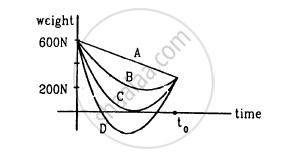
Suppose, the acceleration due to gravity at the earth's surface is 10 m s−2 and at the surface of Mars it is 4⋅0 m s−2. A 60 kg passenger goes from the earth to the Mars in a spaceship moving with a constant velocity. Neglect all other objects in the sky. Which part of the following figure best represents the weight (net gravitational force) of the passenger as a function of time?
If the acceleration due to gravity at the surface of the earth is g, the work done in slowly lifting a body of mass m from the earth's surface to a height R equal to the radius of the earth is
Find the acceleration due to gravity of the moon at a point 1000 km above the moon's surface. The mass of the moon is 7.4 × 10²² kg and its radius is 1740 km.
Find the acceleration due to gravity in a mine of depth 640 m if the value at the surface is 9.800 m s−2. The radius of the earth is 6400 km.
A body is weighed by a spring balance to be 1.000 kg at the North Pole. How much will it weigh at the equator? Account for the earth's rotation only.
A particle is fired vertically upward with a speed of 15 km s−1. With what speed will it move in interstellar space. Assume only earth's gravitational field.
If the acceleration due to gravity becomes 4 times its original value, then escape speed ____________.
Explain the variation of g with altitude.
Calculate the change in g value in your district of Tamil nadu. (Hint: Get the latitude of your district of Tamil nadu from Google). What is the difference in g values at Chennai and Kanyakumari?
A person whose mass is 100 kg travels from Earth to Mars in a spaceship. Neglect all other objects in the sky and take acceleration due to gravity on the surface of the Earth and Mars as 10 m/s2 and 4 m/s2 respectively. Identify from the below figures, the curve that fits best for the weight of the passenger as a function of time.

A pebble is thrown vertically upwards from the bridge with an initial velocity of 4.9 m/s. It strikes the water after 2 s. If acceleration due to gravity is 9.8 m/s2. The height of the bridge and velocity with which the pebble strikes the water will respectively be ______.
If the radius of the earth shrinks by 2% while its mass remains the same. The acceleration due to gravity on the earth's surface will approximately ______.
The mass of a planet is `1/10`th that of the earth and its diameter is half that of the earth. The acceleration due to gravity on that planet is ______.
