Advertisements
Advertisements
Question
As observed from earth, the sun appears to move in an approximate circular orbit. For the motion of another planet like mercury as observed from earth, this would ______.
Options
be similarly true.
not be true because the force between earth and mercury is not inverse square law.
not be true because the major gravitational force on mercury is due to sun.
not be true because mercury is influenced by forces other than gravitational forces.
Advertisements
Solution
As observed from earth, the sun appears to move in an approximate circular orbit. For the motion of another planet like mercury as observed from earth, this would not be true because the major gravitational force on mercury is due to sun.
Explanation:
As observed from the earth, the sun appears to move in an approximately circular orbit. The gravitational force of attraction between the earth and the sun always follows the inverse square law. All planets move around the sun due to the huge gravitational force of the sun acting on them. The gravitational force on the mercury due to the earth is much smaller as compared to that acting on it due to the sun and hence it revolves around the sun and not around the earth.
APPEARS IN
RELATED QUESTIONS
What is the magnitude of the gravitational force between the earth and a 1 kg object on its surface? (Mass of the earth is 6 × 1024 kg and radius of the earth is 6.4 × 10⁶ m).
Calculate the force of gravitation between the earth and the Sun, given that the mass of the earth = 6 × 1024 kg and of the Sun = 2 × 1030 kg. The average distance between the two is 1.5 × 10¹¹ m.
Which of the Kepler’s laws of planetary motion led Newton to establish the inverse-square rule for gravitational force between two bodies ?
Universal law of gravitation states that every object exerts a gravitational force of attraction on every other object. If this is true, why don’t we notice such forces ? Why don’t the two objects in a room move towards each other due to this force ?
Let V and E represent the gravitational potential and field at a distance r from the centre of a uniform solid sphere. Consider the two statements:
(A) the plot of V against r is discontinuous.
(B) The plot of E against r is discontinuous.
Two spherical balls of mass 10 kg each are placed 10 cm apart. Find the gravitational force of attraction between them.
Two small bodies of masses 10 kg and 20 kg are kept a distance 1.0 m apart and released. Assuming that only mutual gravitational forces are acting, find the speeds of the particles when the separation decreases to 0.5 m.
A ball is thrown vertically upwards. It goes to a height 20 m and then returns to the ground. Taking acceleration due to gravity g to be 10 ms-2 , find :
the final velocity of the ball on reaching the ground .
How will the force of gravitation between two objects change if the distance between them is:
Halved
All objects in the universe attract each other along the line joining their________.
The force of attraction between any two material objects is called __________.
A ball is thrown up with a speed of 4.9 ms-1.
Calculate the maximum height it would gain before it begins to fall.
What is meant by the equation :
`g= Gxxm/r^2`
where the symbols have their usual meanings.
A force can produce ________, In an object at rest. It can __________ an object and change its __________ of motion.
What does a force do in the following case?
You catch a kicked ball.
Explain the difference between g and G.
To project the rockets which of the following principle(s) is /(are) required?
The force of gravitation between two bodies of mass 1 kg each separated by a distance of 1 m in vacuum is ____________.
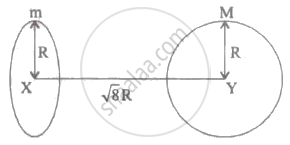
Find the gravitational force of attraction between the ring and sphere as shown in the diagram, where the plane of the ring is perpendicular to the line joining the centres. If `sqrt8` R is the distance between the centres of a ring (of mass 'm')and a sphere (mass 'M') where both have equal radius 'R'.
A hollow spherical shell of uniform density exerts what gravitational force on a point mass placed inside it?
