Advertisements
Advertisements
Question
Explain the variation of g with latitude.
Advertisements
Solution
When an object is on the surface of the Earth, it experiences a centrifugal force that depends on the latitude of the object on Earth. If the Earth were not spinning, the force on the object would have been mg. However, the object experiences an additional centrifugal force due to the spinning of the Earth.
This centrifugal force is given by mω2R’.
OPz, cos λ = `"PZ"/"OP" = "R’"/"R"`
R’ = R cos λ
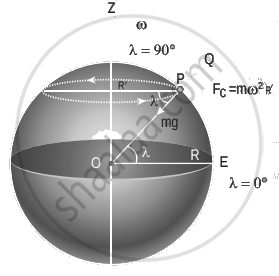
Variation of g with latitude
where λ is the latitude. The component of centrifugal acceleration experienced by the object in the direction opposite to g is
aPQ = ω2R’ cos λ = ω2R cos2 λ
Since R’ = R cos λ
Therefore, g’ = g – ω2 R cos2 λ
From the above expression, we can infer that at the equator, λ = 0, g’ = g – ω2R. The acceleration due to gravity is minimum. At poles λ = 90; g’ = g, it is maximum. At the equator, g’ is minimum.
APPEARS IN
RELATED QUESTIONS
Is there any meaning of “weight of the earth”?
If heavier bodies are attracted more strongly by the earth, why don't they fall faster than the lighter bodies?
An apple falls from a tree. An insect in the apple finds that the earth is falling towards it with an acceleration g. Who exerts the force needed to accelerate the earth with this acceleration g?
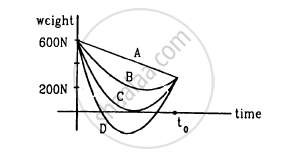
Suppose, the acceleration due to gravity at the earth's surface is 10 m s−2 and at the surface of Mars it is 4⋅0 m s−2. A 60 kg passenger goes from the earth to the Mars in a spaceship moving with a constant velocity. Neglect all other objects in the sky. Which part of the following figure best represents the weight (net gravitational force) of the passenger as a function of time?
What is the acceleration due to gravity on the top of Mount Everest? Mount Everest is the highest mountain peak of the world at the height of 8848 m. The value at sea level is 9.80 m s−2.
A particle is fired vertically upward from earth's surface and it goes up to a maximum height of 6400 km. Find the initial speed of particle.
Explain the variation of g with altitude.
If both the mass and the radius of the earth decrease by 1%, then the value of acceleration due to gravity will
A pebble is thrown vertically upwards from the bridge with an initial velocity of 4.9 m/s. It strikes the water after 2 s. If acceleration due to gravity is 9.8 m/s2. The height of the bridge and velocity with which the pebble strikes the water will respectively be ______.
If the radius of the earth shrinks by 2% while its mass remains the same. The acceleration due to gravity on the earth's surface will approximately ______.
