Advertisements
Advertisements
प्रश्न
Explain the variation of g with latitude.
Advertisements
उत्तर
When an object is on the surface of the Earth, it experiences a centrifugal force that depends on the latitude of the object on Earth. If the Earth were not spinning, the force on the object would have been mg. However, the object experiences an additional centrifugal force due to the spinning of the Earth.
This centrifugal force is given by mω2R’.
OPz, cos λ = `"PZ"/"OP" = "R’"/"R"`
R’ = R cos λ
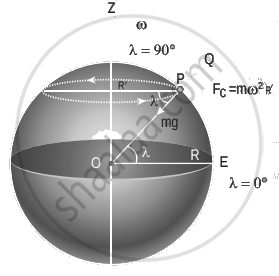
Variation of g with latitude
where λ is the latitude. The component of centrifugal acceleration experienced by the object in the direction opposite to g is
aPQ = ω2R’ cos λ = ω2R cos2 λ
Since R’ = R cos λ
Therefore, g’ = g – ω2 R cos2 λ
From the above expression, we can infer that at the equator, λ = 0, g’ = g – ω2R. The acceleration due to gravity is minimum. At poles λ = 90; g’ = g, it is maximum. At the equator, g’ is minimum.
APPEARS IN
संबंधित प्रश्न
An apple falls from a tree. An insect in the apple finds that the earth is falling towards it with an acceleration g. Who exerts the force needed to accelerate the earth with this acceleration g?
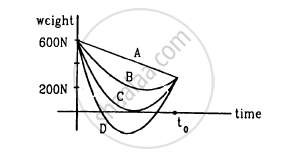
Suppose, the acceleration due to gravity at the earth's surface is 10 m s−2 and at the surface of Mars it is 4⋅0 m s−2. A 60 kg passenger goes from the earth to the Mars in a spaceship moving with a constant velocity. Neglect all other objects in the sky. Which part of the following figure best represents the weight (net gravitational force) of the passenger as a function of time?
If the acceleration due to gravity at the surface of the earth is g, the work done in slowly lifting a body of mass m from the earth's surface to a height R equal to the radius of the earth is
Take the effect of bulging of earth and its rotation in account. Consider the following statements :
(A) There are points outside the earth where the value of g is equal to its value at the equator.
(B) There are points outside the earth where the value of g is equal to its value at the poles.
Find the height over the Earth's surface at which the weight of a body becomes half of its value at the surface.
Which of the following options are correct?
- Acceleration due to gravity decreases with increasing altitude.
- Acceleration due to gravity increases with increasing depth (assume the earth to be a sphere of uniform density).
- Acceleration due to gravity increases with increasing latitude.
- Acceleration due to gravity is independent of the mass of the earth.
A person whose mass is 100 kg travels from Earth to Mars in a spaceship. Neglect all other objects in the sky and take acceleration due to gravity on the surface of the Earth and Mars as 10 m/s2 and 4 m/s2 respectively. Identify from the below figures, the curve that fits best for the weight of the passenger as a function of time.

A ball is immersed in water kept in container and released. At the same time container is accelerated in horizontal direction with acceleration, `sqrt44` m/s2. Acceleration of ball w.r.t. container is ______ m/s2 (specific gravity of ball = 12/17, g = 10 m/s2)
A pebble is thrown vertically upwards from the bridge with an initial velocity of 4.9 m/s. It strikes the water after 2 s. If acceleration due to gravity is 9.8 m/s2. The height of the bridge and velocity with which the pebble strikes the water will respectively be ______.
The percentage decrease in the weight of a rocket, when taken to a height of 32 km above the surface of the earth will, be ______.
(Radius of earth = 6400 km)
