Advertisements
Advertisements
प्रश्न
Explain the variation of g with latitude.
Advertisements
उत्तर
When an object is on the surface of the Earth, it experiences a centrifugal force that depends on the latitude of the object on Earth. If the Earth were not spinning, the force on the object would have been mg. However, the object experiences an additional centrifugal force due to the spinning of the Earth.
This centrifugal force is given by mω2R’.
OPz, cos λ = `"PZ"/"OP" = "R’"/"R"`
R’ = R cos λ
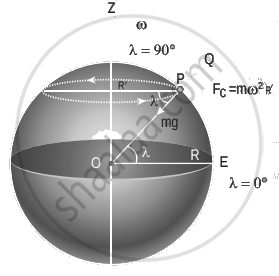
Variation of g with latitude
where λ is the latitude. The component of centrifugal acceleration experienced by the object in the direction opposite to g is
aPQ = ω2R’ cos λ = ω2R cos2 λ
Since R’ = R cos λ
Therefore, g’ = g – ω2 R cos2 λ
From the above expression, we can infer that at the equator, λ = 0, g’ = g – ω2R. The acceleration due to gravity is minimum. At poles λ = 90; g’ = g, it is maximum. At the equator, g’ is minimum.
APPEARS IN
संबंधित प्रश्न
If heavier bodies are attracted more strongly by the earth, why don't they fall faster than the lighter bodies?
The earth revolves round the sun because the sun attracts the earth. The sun also attracts the moon and this force is about twice as large as the attraction of the earth on the moon. Why does the moon not revolve round the sun? Or does it?
An apple falls from a tree. An insect in the apple finds that the earth is falling towards it with an acceleration g. Who exerts the force needed to accelerate the earth with this acceleration g?
If the acceleration due to gravity at the surface of the earth is g, the work done in slowly lifting a body of mass m from the earth's surface to a height R equal to the radius of the earth is
A particle is fired vertically upward from earth's surface and it goes up to a maximum height of 6400 km. Find the initial speed of particle.
A particle is fired vertically upward with a speed of 15 km s−1. With what speed will it move in interstellar space. Assume only earth's gravitational field.
Explain the variation of g with depth from the Earth’s surface.
One can easily weigh the earth by calculating the mass of the earth by using the formula:
The earth is an approximate sphere. If the interior contained matter which is not of the same density everywhere, then on the surface of the earth, the acceleration due to gravity ______.
The mass of a planet is `1/10`th that of the earth and its diameter is half that of the earth. The acceleration due to gravity on that planet is ______.
