Advertisements
Advertisements
प्रश्न
A particle is fired vertically upward from earth's surface and it goes up to a maximum height of 6400 km. Find the initial speed of particle.
Advertisements
उत्तर
The particle attained a maximum height 6400 km, which is equal to the radius of the Earth.
Total energy of the particle on the Earth's surface is given by \[E_e = \frac{1}{2} M V^2 + \left( \frac{- gmM}{r} \right) . . . . \left( 1 \right)\]
Now, total energy of the particle at the maximum height is given by
\[E_3 = \left( \frac{- GMm}{R + h} \right) + 0\]
\[ \Rightarrow E_3 = \left( \frac{- GMm}{2R} \right) . . . \left( 2 \right) \left( \therefore g = R \right)\]
\[- \frac{GMm}{R} + \frac{1}{2}m v^2 = - \frac{GMm}{2R}\]
\[ \Rightarrow \left( \frac{1}{2} \right)m v^2 = GMm\left( - \frac{1}{2R} + \frac{1}{R} \right)\]
\[ \Rightarrow v^2 = \frac{GM}{R}\]
\[ = \frac{6 . 67 \times {10}^{- 11} \times 6 \times {10}^{24}}{6400 \times {10}^3}\]
\[ = \frac{40 . 02 + {10}^{13}}{6 . 4 \times {10}^6}\]
\[ = 6 . 2 \times {10}^7 = 0 . 62 \times {10}^8 \]
\[ \therefore v = \sqrt{0 . 62 \times {10}^8}\]
\[ = 0 . 79 \times {10}^4 m/s\]
\[ = 79 km/s\]
APPEARS IN
संबंधित प्रश्न
If heavier bodies are attracted more strongly by the earth, why don't they fall faster than the lighter bodies?
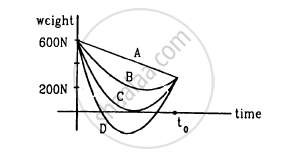
Suppose, the acceleration due to gravity at the earth's surface is 10 m s−2 and at the surface of Mars it is 4⋅0 m s−2. A 60 kg passenger goes from the earth to the Mars in a spaceship moving with a constant velocity. Neglect all other objects in the sky. Which part of the following figure best represents the weight (net gravitational force) of the passenger as a function of time?
If the acceleration due to gravity at the surface of the earth is g, the work done in slowly lifting a body of mass m from the earth's surface to a height R equal to the radius of the earth is
Find the acceleration due to gravity of the moon at a point 1000 km above the moon's surface. The mass of the moon is 7.4 × 10²² kg and its radius is 1740 km.
Find the height over the Earth's surface at which the weight of a body becomes half of its value at the surface.
A body is weighed by a spring balance to be 1.000 kg at the North Pole. How much will it weigh at the equator? Account for the earth's rotation only.
A particle is fired vertically upward with a speed of 15 km s−1. With what speed will it move in interstellar space. Assume only earth's gravitational field.
A mass of 6 × 1024 kg (equal to the mass of the earth) is to be compressed in a sphere in such a way that the escape velocity from its surface is 3 × 10⁸ m s−1. What should be the radius of the sphere?
Explain the variation of g with latitude.
Explain the variation of g with altitude.
Explain the variation of g with depth from the Earth’s surface.
Calculate the change in g value in your district of Tamil nadu. (Hint: Get the latitude of your district of Tamil nadu from Google). What is the difference in g values at Chennai and Kanyakumari?
One can easily weigh the earth by calculating the mass of the earth by using the formula:
Which of the following options are correct?
- Acceleration due to gravity decreases with increasing altitude.
- Acceleration due to gravity increases with increasing depth (assume the earth to be a sphere of uniform density).
- Acceleration due to gravity increases with increasing latitude.
- Acceleration due to gravity is independent of the mass of the earth.
A pebble is thrown vertically upwards from the bridge with an initial velocity of 4.9 m/s. It strikes the water after 2 s. If acceleration due to gravity is 9.8 m/s2. The height of the bridge and velocity with which the pebble strikes the water will respectively be ______.
The percentage decrease in the weight of a rocket, when taken to a height of 32 km above the surface of the earth will, be ______.
(Radius of earth = 6400 km)
