Advertisements
Advertisements
प्रश्न
A body is weighed by a spring balance to be 1.000 kg at the North Pole. How much will it weigh at the equator? Account for the earth's rotation only.
Advertisements
उत्तर
Let gp be the acceleration due to gravity at the poles.
Let ge be the acceleration due to gravity at the equator.
Now, acceleration due to gravity at the equator is given by ge = gp \[-\] ω2r
= 9.81 − (7.3 × 10⁻⁵)2 × 6400 × 103
= 9.81 − (53.29 × 10−10) × 64 × 105
= 9.81 − 0.034 = 9.776 m/s2
Now, mge = 1 kg × 9.776 m/s2
= 9.776 N
∴ The body will weigh 9.776 N at the equator.
APPEARS IN
संबंधित प्रश्न
An apple falls from a tree. An insect in the apple finds that the earth is falling towards it with an acceleration g. Who exerts the force needed to accelerate the earth with this acceleration g?
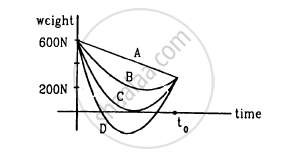
Suppose, the acceleration due to gravity at the earth's surface is 10 m s−2 and at the surface of Mars it is 4⋅0 m s−2. A 60 kg passenger goes from the earth to the Mars in a spaceship moving with a constant velocity. Neglect all other objects in the sky. Which part of the following figure best represents the weight (net gravitational force) of the passenger as a function of time?
If the acceleration due to gravity at the surface of the earth is g, the work done in slowly lifting a body of mass m from the earth's surface to a height R equal to the radius of the earth is
Take the effect of bulging of earth and its rotation in account. Consider the following statements :
(A) There are points outside the earth where the value of g is equal to its value at the equator.
(B) There are points outside the earth where the value of g is equal to its value at the poles.
Find the acceleration due to gravity of the moon at a point 1000 km above the moon's surface. The mass of the moon is 7.4 × 10²² kg and its radius is 1740 km.
What is the acceleration due to gravity on the top of Mount Everest? Mount Everest is the highest mountain peak of the world at the height of 8848 m. The value at sea level is 9.80 m s−2.
A particle is fired vertically upward from earth's surface and it goes up to a maximum height of 6400 km. Find the initial speed of particle.
If the acceleration due to gravity becomes 4 times its original value, then escape speed ____________.
Explain the variation of g with latitude.
Explain the variation of g with depth from the Earth’s surface.
Suppose we go 200 km above and below the surface of the Earth, what are the g values at these two points? In which case, is the value of g small?
Calculate the change in g value in your district of Tamil nadu. (Hint: Get the latitude of your district of Tamil nadu from Google). What is the difference in g values at Chennai and Kanyakumari?
If both the mass and the radius of the earth decrease by 1%, then the value of acceleration due to gravity will
The earth is an approximate sphere. If the interior contained matter which is not of the same density everywhere, then on the surface of the earth, the acceleration due to gravity ______.
A ball is immersed in water kept in container and released. At the same time container is accelerated in horizontal direction with acceleration, `sqrt44` m/s2. Acceleration of ball w.r.t. container is ______ m/s2 (specific gravity of ball = 12/17, g = 10 m/s2)
The percentage decrease in the weight of a rocket, when taken to a height of 32 km above the surface of the earth will, be ______.
(Radius of earth = 6400 km)
