Advertisements
Advertisements
प्रश्न
A body is suspended from a spring balance kept in a satellite. The reading of the balance is W1 when the satellite goes in an orbit of radius R and is W2 when it goes in an orbit of radius 2 −R.
पर्याय
W1 = W2
W1 < W2
W1 > W2
W1 ≠ W2
Advertisements
उत्तर
W1 = W2
The gravitational pull on the satellite in both cases is used up in providing the necessary centripetal force required for its revolution around the earth. This means that there is no net force acting on the body which has been suspended from a spring balance in the satellite. So, the readings of the spring balance in both the cases are the same and is equal to zero.
APPEARS IN
संबंधित प्रश्न
What happens to the force between two objects, if the masses of both objects are doubled?
A rocket is fired from the earth towards the sun. At what distance from the earth’s centre is the gravitational force on the rocket zero? Mass of the sun = 2 ×1030 kg, mass of the earth = 6 × 1024 kg. Neglect the effect of other planets etc. (orbital radius = 1.5 × 10¹¹ m).
How will you ‘weigh the sun’, that is estimate its mass? The mean orbital radius of the earth around the sun is 1.5 × 10⁸ km.
Derive an expression for the gravitational field due to a uniform rod of length L and mass M at a point on its perpendicular bisector at a distance d from the centre.
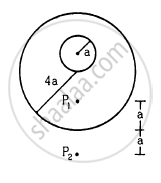
A uniform metal sphere of radius a and mass M is surrounded by a thin uniform spherical shell of equal mass and radius 4a (In the following figure). The centre of the shell falls on the surface of the inner sphere. Find the gravitational field at the points P1 and P2 shown in the figure.
How will the force of gravitation between two objects change if the distance between them is:
Almost zero
A ball is thrown up with a speed of 4.9 ms-1.
Calculate the maximum height it would gain before it begins to fall.
You can change the direction in which an object is moving by___________.
Name and state the action and reaction in the following case:
Hammering a nail.
Gravity is another kind of ________. It exerts all through the ________. The Sun's gravity keeps the ___________ in their orbits. Gravity can only be felt with very large ________.
Explain why:
The atmosphere does not escape.
The ______ force is much weaker than other forces in nature.
Three uniform spheres, each having mass m and radius r, are kept in such a way that each touches the other two. The magnitude of the gravitational force on any sphere due to the other two is
How is the gravitational force between two point masses affected when they are dipped in water keeping the separation between them the same?
If three equal masses m are placed at the three vertices of an equilateral triangle of side 1/m then what force acts on a particle of mass 2m placed at the centroid?
The Superposition Principle states that the net gravitational force on an object is ______.
Newton formulated the Universal Law of Gravitation by combining the ideas of which two scientists with his own Laws of Motion?
