Advertisements
Advertisements
प्रश्न
What does a force do in the following case?
You twist a piece of rubber.
Advertisements
उत्तर
Force produces stretching in the rubber.
APPEARS IN
संबंधित प्रश्न
Which of the Kepler’s laws of planetary motion led Newton to establish the inverse-square rule for gravitational force between two bodies ?
Can you think of two particles which do not exert gravitational force on each other?
A body is suspended from a spring balance kept in a satellite. The reading of the balance is W1 when the satellite goes in an orbit of radius R and is W2 when it goes in an orbit of radius 2 −R.
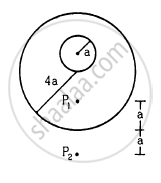
A uniform metal sphere of radius a and mass M is surrounded by a thin uniform spherical shell of equal mass and radius 4a (In the following figure). The centre of the shell falls on the surface of the inner sphere. Find the gravitational field at the points P1 and P2 shown in the figure.
How will the force of gravitation between two objects change if the distance between them is:
Doubled
Name and state the action and reaction in the following case:
A book lying on a table.
Why does a ball moving on a table top eventually stops?
Two equal and opposite forces acting at the same point on a stationary body. Will the body move? Give reason to explain your answer.
Law of gravitation gives the gravitational force between
Newton's universal law of gravitation applies to ______.
