Advertisements
Advertisements
प्रश्न
Why does a ball moving on a table top eventually stops?
Advertisements
उत्तर
Ball moving on a table top stops eventually due to force of friction between the ball surface and table surface.
APPEARS IN
संबंधित प्रश्न
Choose the correct alternative:
Acceleration due to gravity is independent of mass of the earth/mass of the body.
The gravitational intensity at the centre of a hemispherical shell of uniform mass density has the direction indicated by the arrow (see Fig 8.12) (i) a, (ii) b, (iii) c, (iv) 0.
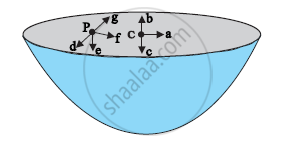
A person brings a mass of 1 kg from infinity to a point A. Initially the mass was at rest but it moves at a speed of 2 m s −1 as it reaches A. The work done by the person on the mass is −3 J. The potential at A is
Let V and E be the gravitational potential and gravitational field at a distance r from the centre of a uniform spherical shell. Consider the following two statements :
(A) The plot of V against r is discontinuous.
(B) The plot of E against r is discontinuous.
Is the law of gravitation applicable in case of the sun and the moon?
What is meant by the equation :
`g= Gxxm/r^2`
where the symbols have their usual meanings.
Name and state the action and reaction in the following case:
A book lying on a table.
State Newton's law of gravitation. What is the difference between:
g and G?
The gravitational force between two bodies is directly proportional to the product of the masses of those bodies and is ______ of the distance between them.
The value of universal gravitational constant (G) in the SI unit is ______.
