Advertisements
Advertisements
प्रश्न
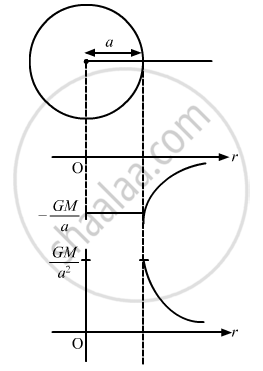
Let V and E be the gravitational potential and gravitational field at a distance r from the centre of a uniform spherical shell. Consider the following two statements :
(A) The plot of V against r is discontinuous.
(B) The plot of E against r is discontinuous.
पर्याय
Both A and B are correct.
A is correct but B is wrong.
B is correct but A is wrong.
Both A and B are wrong.
Advertisements
उत्तर
B is correct but A is wrong.
The plot of E against r is discontinuous as gravitational field inside the spherical shell is zero (r < R). The plot of V against r is a continuous curve for a uniform spherical shell.
APPEARS IN
संबंधित प्रश्न
If the moon attracts the earth, why does the earth not move towards the moon?
What happens to the force between two objects, if the distance between the objects is doubled and tripled?
Choose the correct alternative:
Acceleration due to gravity increases/decreases with increasing depth. (assume the earth to be a sphere of uniform density).
How will you ‘weigh the sun’, that is estimate its mass? The mean orbital radius of the earth around the sun is 1.5 × 10⁸ km.
Can we apply Newton’s third law to the gravitational force ? Explain your answer.
State and explain Kepler's laws of planetary motion. Draw diagrams to illustrate these laws.
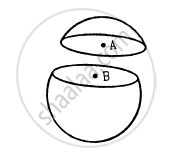
A thin spherical shell having uniform density is cut in two parts by a plane and kept separated as shown in the following figure. The point A is the centre of the plane section of the first part and B is the centre of the plane section of the second part. Show that the gravitational field at A due to the first part is equal in magnitude to the gravitational field at B due to the second part.
A particle of mass 100 g is kept on the surface of a uniform sphere of mass 10 kg and radius 10 cm. Find the work to be done against the gravitational force between them to take the particle away from the sphere.
The force of attraction between any two material objects is called __________.
Where will you weigh more: at the moon's surface or at the earth's surface?
At what height above the earth's surface would the value of acceleration due to gravity be half of what it is on the surface? Take the radius of earth to be R.
State Newton’s universal law of gravitation. Express it with the mathematical form of force of gravitation?
For the weight of body of mass 5 kg to be zero on equator of the earth, angular velocity of the earth must be (The radius of earth = 6400 km, acceleration due to gravity = 10 m/s2).
Particles of masses 2M, m and M are respectively at points A, B and C with AB = ½ (BC). m is much-much smaller than M and at time t = 0, they are all at rest (Figure). At subsequent times before any collision takes place ______.

If the law of gravitation, instead of being inverse-square law, becomes an inverse-cube law- ______.
- planets will not have elliptic orbits.
- circular orbits of planets is not possible.
- projectile motion of a stone thrown by hand on the surface of the earth will be approximately parabolic.
- there will be no gravitational force inside a spherical shell of uniform density.
Six point masses of mass m each are at the vertices of a regular hexagon of side l. Calculate the force on any of the masses.
Four identical particles of equal masses 1 kg made to move along the circumference of a circle of radius 1 m under the action of their own mutual gravitational attraction. The speed of each particle will be ______.
The Superposition Principle states that the net gravitational force on an object is ______.
The gravitational force between two objects acts in which direction?
