Advertisements
Advertisements
प्रश्न
Particles of masses 2M, m and M are respectively at points A, B and C with AB = ½ (BC). m is much-much smaller than M and at time t = 0, they are all at rest (Figure). At subsequent times before any collision takes place ______.

पर्याय
m will remain at rest.
m will move towards M.
m will move towards 2M.
m will have oscillatory motion.
Advertisements
उत्तर
Particles of masses 2M, m and M are respectively at points A, B and C with AB = ½ (BC). m is much-much smaller than M and at time t = 0, they are all at rest (Figure). At subsequent times before any collision takes place m will move towards 2M..
Explanation:
The particle m at B will move towards A with the greater force, due to particle 2M at A.
Force on m at B due to 2M at A is
`F_(BA) = (G(m xx 2M))/(AB)^2` towards `BA`
Force on mass m at B due to mass M at C is
`F_(BC) = (G(M xx M))/(BC)^2` towards `BC`
Therefore, the resultant force on mass m at B due to masses M and 2M is
`F_"net" = F_(BA) - F_(BC)` .....(Because FBA and FBC are acting in opposite directions)
`F_"net" = (2GMm)/(AB)^2 - (GMm)/(BC)^2`
As `(BC) = 2AB`
⇒ `F_"net" = (2GMm)/(AB)^2 - (GMm)/(2AB)^2`
= `(2GMm)/(AB)^2 - (GMm)/(4(AB)^2`
= `(7GMm)/(4(AB)^2` (along BA)
Hence, m will move towards BA (i.e., 2M).
APPEARS IN
संबंधित प्रश्न
If the moon attracts the earth, why does the earth not move towards the moon?
Choose the correct alternative:
Acceleration due to gravity increases/decreases with increasing altitude.
Choose the correct alternative:
Acceleration due to gravity is independent of mass of the earth/mass of the body.
The gravitational intensity at the centre of a hemispherical shell of uniform mass density has the direction indicated by the arrow (see Fig 8.12) (i) a, (ii) b, (iii) c, (iv) 0.
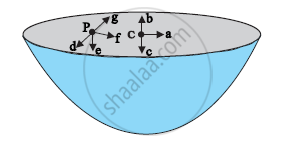
A rocket is fired from the earth towards the sun. At what distance from the earth’s centre is the gravitational force on the rocket zero? Mass of the sun = 2 ×1030 kg, mass of the earth = 6 × 1024 kg. Neglect the effect of other planets etc. (orbital radius = 1.5 × 10¹¹ m).
How will you ‘weigh the sun’, that is estimate its mass? The mean orbital radius of the earth around the sun is 1.5 × 10⁸ km.
A ball is thrown vertically upwards. It goes to a height 20 m and then returns to the ground. Taking acceleration due to gravity g to be 10 ms-2 , find :
the final velocity of the ball on reaching the ground .
How will the force of gravitation between two objects change if the distance between them is:
Halved
How will the force of gravitation between two objects change if the distance between them is:
Infinite
The force of attraction between any two material objects is called __________.
Why don't you feel the force of attraction between your friend sitting close to you and yourself?
Explain the difference between g and G.
Different points in earth are at slightly different distances from the sun and hence experience different forces due to gravitation. For a rigid body, we know that if various forces act at various points in it, the resultant motion is as if a net force acts on the c.m. (centre of mass) causing translation and a net torque at the c.m. causing rotation around an axis through the c.m. For the earth-sun system (approximating the earth as a uniform density sphere).
If the law of gravitation, instead of being inverse-square law, becomes an inverse-cube law- ______.
- planets will not have elliptic orbits.
- circular orbits of planets is not possible.
- projectile motion of a stone thrown by hand on the surface of the earth will be approximately parabolic.
- there will be no gravitational force inside a spherical shell of uniform density.
Shown are several curves (Figure). Explain with reason, which ones amongst them can be possible trajectories traced by a projectile (neglect air friction).
Write the answer of the question with reference to laws of gravitation.
Write the value of the universal gravitational constant.
Newton's universal law of gravitation applies to ______.
If the mass of one object is doubled and distance remains the same, the gravitational force will ______.
If the distance between two objects is doubled, the gravitational force becomes ______.
