Advertisements
Advertisements
Question
Particles of masses 2M, m and M are respectively at points A, B and C with AB = ½ (BC). m is much-much smaller than M and at time t = 0, they are all at rest (Figure). At subsequent times before any collision takes place ______.

Options
m will remain at rest.
m will move towards M.
m will move towards 2M.
m will have oscillatory motion.
Advertisements
Solution
Particles of masses 2M, m and M are respectively at points A, B and C with AB = ½ (BC). m is much-much smaller than M and at time t = 0, they are all at rest (Figure). At subsequent times before any collision takes place m will move towards 2M..
Explanation:
The particle m at B will move towards A with the greater force, due to particle 2M at A.
Force on m at B due to 2M at A is
`F_(BA) = (G(m xx 2M))/(AB)^2` towards `BA`
Force on mass m at B due to mass M at C is
`F_(BC) = (G(M xx M))/(BC)^2` towards `BC`
Therefore, the resultant force on mass m at B due to masses M and 2M is
`F_"net" = F_(BA) - F_(BC)` .....(Because FBA and FBC are acting in opposite directions)
`F_"net" = (2GMm)/(AB)^2 - (GMm)/(BC)^2`
As `(BC) = 2AB`
⇒ `F_"net" = (2GMm)/(AB)^2 - (GMm)/(2AB)^2`
= `(2GMm)/(AB)^2 - (GMm)/(4(AB)^2`
= `(7GMm)/(4(AB)^2` (along BA)
Hence, m will move towards BA (i.e., 2M).
APPEARS IN
RELATED QUESTIONS
What happens to the force between two objects, if the masses of both objects are doubled?
Answer the following:
An astronaut inside a small space ship orbiting around the earth cannot detect gravity. If the space station orbiting around the earth has a large size, can he hope to detect gravity?
Choose the correct alternative:
Acceleration due to gravity increases/decreases with increasing altitude.
Which of the Kepler’s laws of planetary motion led Newton to establish the inverse-square rule for gravitational force between two bodies ?
Suppose the gravitational potential due to a small system is k/r2 at a distance r from it. What will be the gravitational field? Can you think of any such system? What happens if there were negative masses?
Let V and E be the gravitational potential and gravitational field at a distance r from the centre of a uniform spherical shell. Consider the following two statements :
(A) The plot of V against r is discontinuous.
(B) The plot of E against r is discontinuous.
Consider a planet moving in an elliptical orbit round the sun. The work done on the planet by the gravitational force of the sun
(a) is zero in any small part of the orbit
(b) is zero in some parts of the orbit
(c) is zero in one complete revolution
(d) is zero in no part of the motion.
Four particles having masses m, 2m, 3m and 4m are placed at the four corners of a square of edge a. Find the gravitational force acting on a particle of mass m placed at the centre.
Three equal masses m are placed at the three corners of an equilateral triangle of side a. Find the force exerted by this system on another particle of mass m placed at (a) the mid-point of a side, (b) at the centre of the triangle.
Who stated the law of gravitation?
What is meant by the equation :
`g= Gxxm/r^2`
where the symbols have their usual meanings.
You can change the direction in which an object is moving by___________.
Two equal and opposite forces acting at the same point on a stationary body. Will the body move? Give reason to explain your answer.
The gravitational force between two bodies is directly proportional to the product of the masses of those bodies and is ______ of the distance between them.
Three uniform spheres, each having mass m and radius r, are kept in such a way that each touches the other two. The magnitude of the gravitational force on any sphere due to the other two is
We can shield a charge from electric fields by putting it inside a hollow conductor. Can we shield a body from the gravitational influence of nearby matter by putting it inside a hollow sphere or by some other means?
Two particles of equal mass 'm' go around a circle of radius R under the action of their mutual gravitational attraction. The speed of each particle with respect to its centre of mass is ______.
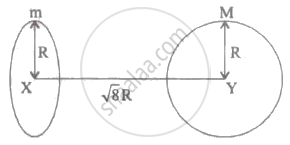
Find the gravitational force of attraction between the ring and sphere as shown in the diagram, where the plane of the ring is perpendicular to the line joining the centres. If `sqrt8` R is the distance between the centres of a ring (of mass 'm')and a sphere (mass 'M') where both have equal radius 'R'.
Ocean tides on Earth are mainly caused by ______.
