Advertisements
Advertisements
प्रश्न
Give scientific reasons for the following:
Newton's gravitational law is the universal law of gravitation.
Advertisements
उत्तर
Newton's gravitational law is applicable throughout the universe and to all particles. Hence, it is called the universal law of gravitation.
APPEARS IN
संबंधित प्रश्न
State the universal law of gravitation. Name the scientist who gave this law.
State and explain Kepler's laws of planetary motion. Draw diagrams to illustrate these laws.
Can two particles be in equilibrium under the action of their mutual gravitational force? Can three particles be? Can one of the three particles be?
A person brings a mass of 1 kg from infinity to a point A. Initially the mass was at rest but it moves at a speed of 2 m s −1 as it reaches A. The work done by the person on the mass is −3 J. The potential at A is
Three equal masses m are placed at the three corners of an equilateral triangle of side a. Find the force exerted by this system on another particle of mass m placed at (a) the mid-point of a side, (b) at the centre of the triangle.
Three uniform spheres each having a mass M and radius a are kept in such a way that each touches the other two. Find the magnitude of the gravitational force on any of the spheres due to the other two.
Multiple Choice Question. Select the correct option.
The mass of earth is 6 × 1024 kg and radius of earth is 6.4 × 10⁶ m. The magnitude of force between the mass of 1 kg and the earth is:
The force of attraction between any two material objects is called __________.
What does a force do in the following case?
You twist a piece of rubber.
Two equal and opposite forces acting at the same point on a stationary body. Will the body move? Give reason to explain your answer.
The gravitational force between two bodies is directly proportional to the product of the masses of those bodies and is ______ of the distance between them.
The force of gravitation between two bodies of mass 1 kg each separated by a distance of 1 m in vacuum is ____________.
Choose the wrong option.
The gravitational force between a hollow spherical shell (of radius R and uniform density) and a point mass is F. Show the nature of F vs r graph where r is the distance of the point from the centre of the hollow spherical shell of uniform density.
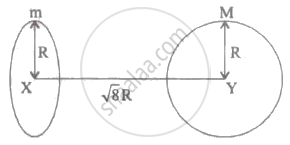
Find the gravitational force of attraction between the ring and sphere as shown in the diagram, where the plane of the ring is perpendicular to the line joining the centres. If `sqrt8` R is the distance between the centres of a ring (of mass 'm')and a sphere (mass 'M') where both have equal radius 'R'.
If three equal masses m are placed at the three vertices of an equilateral triangle of side 1/m then what force acts on a particle of mass 2m placed at the centroid?
Ocean tides on Earth are mainly caused by ______.
Newton formulated the Universal Law of Gravitation by combining the ideas of which two scientists with his own Laws of Motion?
