Advertisements
Advertisements
प्रश्न
Derive an expression for the gravitational field due to a uniform rod of length L and mass M at a point on its perpendicular bisector at a distance d from the centre.
Advertisements
उत्तर
Consider a small mass element of length dx at a distance x from the centre of the rod.
Mass of the mass element, dm = (M/L) × dx
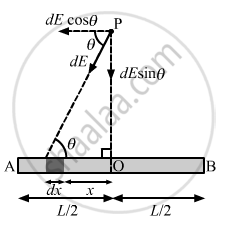
Gravitational field due to this element at point P is given by \[dE = \frac{G\left( dm \right) \times 1}{\left( d^2 + x^2 \right)}\]
The components of the gravitational field due to the symmetrical mass element along the length of the rod cancel each other.
Now, resultant gravitational field = 2dE sin θ
\[= 2 \times \frac{G\left( dm \right)}{\left( d^2 + x^2 \right)} \times \frac{d}{\sqrt{\left( d^2 + x^2 \right)}}\]
\[ = \frac{2 \times GM \times d dx}{L\left( d^2 + x^2 \right) \left\{ \left( \sqrt{d^2 + x^2} \right) \right\}}\]
Total gravitational field due to the rod at point P is given by \[E = \int_0^{L/2} \frac{2Gmd \ dx}{L \left( d^2 + x^2 \right)^{3/2}}\]
APPEARS IN
संबंधित प्रश्न
Write the answer of the question with reference to laws of gravitation.
State the universal law of gravitation.
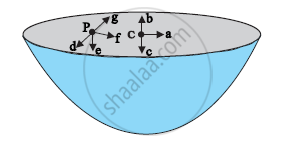
The gravitational intensity at the centre of a hemispherical shell of uniform mass density has the direction indicated by the arrow (see Fig 8.12) (i) a, (ii) b, (iii) c, (iv) 0.
State the universal law of gravitation. Name the scientist who gave this law.
Write the three laws given by Kepler. How did they help Newton to arrive at the inverse square law of gravity?
Can you think of two particles which do not exert gravitational force on each other?
Inside a uniform spherical shell
(a) the gravitational potential is zero
(b) the gravitational field is zero
(c) the gravitational potential is same everywhere
(d) the gravitational field is same everywhere
Which of the following quantities remain constant in a planetary motion (consider elliptical orbits) as seen from the sun?
Three uniform spheres each having a mass M and radius a are kept in such a way that each touches the other two. Find the magnitude of the gravitational force on any of the spheres due to the other two.
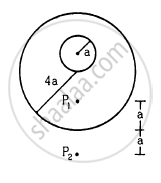
A uniform metal sphere of radius a and mass M is surrounded by a thin uniform spherical shell of equal mass and radius 4a (In the following figure). The centre of the shell falls on the surface of the inner sphere. Find the gravitational field at the points P1 and P2 shown in the figure.
A particle of mass 100 g is kept on the surface of a uniform sphere of mass 10 kg and radius 10 cm. Find the work to be done against the gravitational force between them to take the particle away from the sphere.
The gravitational field in a region is given by \[E = \left( 2 \overrightarrow{i} + 3 \overrightarrow{j} \right) N {kg}^{- 1}\] . Show that no work is done by the gravitational field when a particle is moved on the line 3y + 2x = 5.
[Hint : If a line y = mx + c makes angle θ with the X-axis, m = tan θ.]
Explain the following:
People often shake the branches of a tree for getting down its fruits.
Multiple Choice Question. Select the correct option.
The mass of earth is 6 × 1024 kg and radius of earth is 6.4 × 10⁶ m. The magnitude of force between the mass of 1 kg and the earth is:
Distinguish between gravity and gravitation
How will the force of gravitation between two objects change if the distance between them is:
Infinite
How will the force of gravitation between two objects change if the distance between them is:
Almost zero
You can change the direction in which an object is moving by___________.
What do you mean by a gravitational constant?
Two particles of equal mass 'm' go around a circle of radius R under the action of their mutual gravitational attraction. The speed of each particle with respect to its centre of mass is ______.
The Superposition Principle states that the net gravitational force on an object is ______.
