Advertisements
Advertisements
प्रश्न
Two concentric spherical shells have masses M1, M2 and radii R1, R2 (R1 < R2). What is the force exerted by this system on a particle of mass m1 if it is placed at a distance (R1+ R2)/2 from the centre?
Advertisements
उत्तर
Consider that mass m is at a distance \[\frac{R_1 + R_2}{2}\] as shown in the figure.
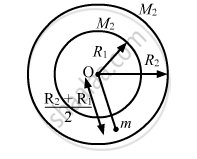
The gravitational force of m due to the shell of M2 is zero, because the mass is inside the shell.
∴ Gravitational force due to the shell of mass M2 = \[\frac{G M_1 m}{\left( \frac{R_1 + R_2}{2} \right)^2} = \frac{4G M_1 m}{\left( R_1 + R_2 \right)^2}\]
APPEARS IN
संबंधित प्रश्न
Write the answer of the question with reference to laws of gravitation.
State the universal law of gravitation.
How does the force of gravitation between two objects change when the distance between them is reduced to half?
Can we apply Newton’s third law to the gravitational force ? Explain your answer.
Write the three laws given by Kepler. How did they help Newton to arrive at the inverse square law of gravity?
Can you think of two particles which do not exert gravitational force on each other?
Consider a planet moving in an elliptical orbit round the sun. The work done on the planet by the gravitational force of the sun
(a) is zero in any small part of the orbit
(b) is zero in some parts of the orbit
(c) is zero in one complete revolution
(d) is zero in no part of the motion.
Two spherical balls of mass 10 kg each are placed 10 cm apart. Find the gravitational force of attraction between them.
Three equal masses m are placed at the three corners of an equilateral triangle of side a. Find the force exerted by this system on another particle of mass m placed at (a) the mid-point of a side, (b) at the centre of the triangle.
The acceleration produced by a force in an object is directly proportional to the applied _________ And inversely proportional to the _________ Of the object.
How will the force of gravitation between two objects change if the distance between them is:
Almost zero
Why don't you feel the force of attraction between your friend sitting close to you and yourself?
A ball is thrown up with a speed of 4.9 ms-1.
Calculate the time it takes to reach this height.
Where will you weigh more: at the moon's surface or at the earth's surface?
What is meant by the equation :
`g= Gxxm/r^2`
where the symbols have their usual meanings.
Gravity is another kind of ________. It exerts all through the ________. The Sun's gravity keeps the ___________ in their orbits. Gravity can only be felt with very large ________.
Show that gravity decreases at higher altitudes.
Solve the following problem.
Calculate the acceleration due to gravity at a height of 300 km from the surface of the Earth. (M = 5.98 × 1024 kg, R = 6400 km).
The ______ force is much weaker than other forces in nature.
Write the answer of the question with reference to laws of gravitation.
Write the value of the universal gravitational constant.
If the mass of one object is doubled and distance remains the same, the gravitational force will ______.
