Advertisements
Advertisements
प्रश्न
The gravitational force between a hollow spherical shell (of radius R and uniform density) and a point mass is F. Show the nature of F vs r graph where r is the distance of the point from the centre of the hollow spherical shell of uniform density.
Advertisements
उत्तर
Let us consider the diagram of a spherical shell having uniform density (ρ).

Mass of the shell = (Density) × (Volume)
`M = (ρ) xx 4/3 πR^3`
Therefore, the gravitational force between the hollow shell and point mass is`F = (GMm)/r^2` where M is the mass of the hollow spherical shell and m is the mass of point mass.
Therefore, the mass is distributed on the surface of the sphere only, then F = 0 for 0 < r < R (i.e., force inside the shell is zero)
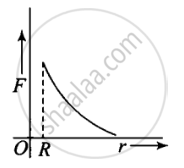
And `F = (GM)/r^2 for `r ≥ R`
The variation of F versus r is shown in the diagram. Force is maximum at the surface of shell and it is zero if r tends to infinity.
APPEARS IN
संबंधित प्रश्न
How does the force of gravitation between two objects change when the distance between them is reduced to half?
What is the importance of the universal law of gravitation?
The weight of an object is more at the poles than at the equator. Is it beneficial to purchase goods at equator and sell them at the pole? Does it matter whether a spring balance is used or an equal-beam balance is used?
A body is suspended from a spring balance kept in a satellite. The reading of the balance is W1 when the satellite goes in an orbit of radius R and is W2 when it goes in an orbit of radius 2 −R.
Two spherical balls of mass 10 kg each are placed 10 cm apart. Find the gravitational force of attraction between them.
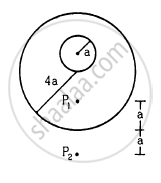
A uniform metal sphere of radius a and mass M is surrounded by a thin uniform spherical shell of equal mass and radius 4a (In the following figure). The centre of the shell falls on the surface of the inner sphere. Find the gravitational field at the points P1 and P2 shown in the figure.
Who stated the law of gravitation?
How will the force of gravitation between two objects change if the distance between them is:
Halved
The force of attraction between any two material objects is called __________.
Where will you weigh more: at the centre of the earth or at the surface of the earth?
What is the difference between gravity and gravitation?
Answer the following question.
What are the dimensions of the universal gravitational constant?
Answer the following question.
State Newton’s law of gravitation and express it in vector form.
Solve the following problem.
Calculate the acceleration due to gravity at a height of 300 km from the surface of the Earth. (M = 5.98 × 1024 kg, R = 6400 km).
State Newton’s universal law of gravitation. Express it with the mathematical form of force of gravitation?
Choose the wrong option.
How is the gravitational force between two point masses affected when they are dipped in water keeping the separation between them the same?
Shown are several curves (Figure). Explain with reason, which ones amongst them can be possible trajectories traced by a projectile (neglect air friction).
Two particles of equal mass 'm' go around a circle of radius R under the action of their mutual gravitational attraction. The speed of each particle with respect to its centre of mass is ______.
If three equal masses m are placed at the three vertices of an equilateral triangle of side 1/m then what force acts on a particle of mass 2m placed at the centroid?
