Advertisements
Advertisements
प्रश्न
Out of aphelion and perihelion, where is the speed of the earth more and why?
Advertisements
उत्तर
Aphelion is the location of the earth where it is at the greatest distance from the sun and perihelion is the location of the earth where it is at the nearest distance from the sun. According to the diagram given below point A represents aphelion and point P perihelion.

According to Kepler's second law, a real velocity is constant. So, `r_p xx v_p = r_A xx v_A`
⇒ `r_A/r_p = v_p/v_A`
Therefore, `r_A > r_p`. So `v_p > v_A`
Therefore, the speed of the earth is more at the perihelion than at the aphelion.
APPEARS IN
संबंधित प्रश्न
Let us assume that our galaxy consists of 2.5 × 10¹¹ stars each of one solar mass. How long will a star at a distance of 50,000 ly from the galactic centre take to complete one revolution? Take the diameter of the Milky Way to be 105 ly
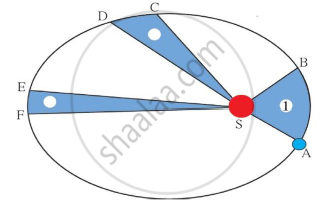
Identify the law shown in the figure and state three respective laws.
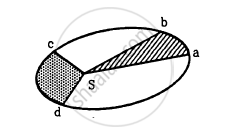
In the Following figure shows the elliptical path of a planet about the sun. The two shaded parts have equal area. If t1 and t2 be the time taken by the planet to go from a to b and from c to d respectively,
The square of its period of revolution around the sun is directly proportional to the ______ of the mean distance of a planet from the sun.
If the distance between the sun and the earth is made three times, then attraction between the two will ______
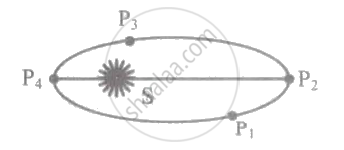
A planet is revolving around the sun in an elliptical orbit as shown in figure. At which point will its K.E. be maximum?
The mass and radius of earth is 'Me' and 'Re' respectively and that of moon is 'Mm' and 'Rm' respectively. The distance between the centre of the earth and that of moon is 'D'. The minimum speed required for a body (mass 'm') to project from a point midway between their centres to escape to infinity is ______.
To verify Kepler's third law graphically four students plotted graphs. Student A plotted a graph of T (period of revolution of planets) versus r (average distance of planets from the sun) and found the plot is straight line with slope 1.85. Student B plotted a graph of T2 v/s r3 and found the plot is straight line with slope 1.39 and negative Y-intercept. Student C plotted graph of log T v/s log r and found the plot is straight line with slope 1.5. Student D plotted graph of log T v/s log r and found the plot is straight line with slope 0.67 and with negative X-intercept. The correct graph is of student
A planet revolves in an elliptical orbit around the sun. The semi-major and minor axes are a and b, then the time period is given by:
Supposing Newton’s law of gravitation for gravitation forces F1 and F2 between two masses m1 and m2 at positions r1 and r2 read F1 = – F2 = `- r_12/r_12^3 GM_0^2 ((m_1m_2)/M_0^2)^n` where M0 is a constant of dimension of mass r12 = r1 – r2 and n is a number. in such a case.
- the acceleration due to gravity on earth will be different for different objects.
- none of the three laws of Kepler will be valid.
- only the third law will become invalid.
- for n negative, an object lighter than water will sink in water.
Give one example each of central force and non-central force.
Draw areal velocity versus time graph for mars.
Earth’s orbit is an ellipse with eccentricity 0.0167. Thus, earth’s distance from the sun and speed as it moves around the sun varies from day to day. This means that the length of the solar day is not constant through the year. Assume that earth’s spin axis is normal to its orbital plane and find out the length of the shortest and the longest day. A day should be taken from noon to noon. Does this explain variation of length of the day during the year?
The maximum and minimum distances of a comet from the Sun are 1.6 × 10¹² m and 8.0 × 10¹⁰ m respectively. If the speed of the comet at the nearest point is 6 × 10⁴ ms-1, the speed at the farthest point is ______.
Halley's Comet revolves around the sun for a time period of 76 years. The aphelion distance if perihelion is given by 8.9 × 10¹⁰ m, will be ______.
(Take, the mass of sun = 2 × 1030 kg and G = 6.67 × 10⁻¹¹ Nm3/kg2)
What is one practical use of Kepler’s laws?
