Advertisements
Advertisements
Question
Show the nature of the following graph for a satellite orbiting the earth.
- KE vs orbital radius R
- PE vs orbital radius R
- TE vs orbital radius R.
Advertisements
Solution
Consider the diagram, where a satellite of mass m, moves around the earth in a circular orbit of radius R.

The orbital speed of the satellite orbiting the earth is given by `v_0 = sqrt((GM)/R)` where M and R are the mass and radius of the earth.
a. ∴ KE of a satellite of mass m,
= `1/2 mv_0^2 `
= `1/2m xx (GM)/R`
∴ `E_k ∝ 1/R`

It means the KE decrease exponentially with radius. The graph for KE versus orbital radius R is shown in figure.
b. Potential energy of a satellite `E-p = - (GMn)/R`
`E_p ∝ 1/R`
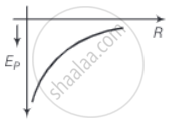
The graph for PE versus orbital radius R is shown in figure.
c. Total energy of the satellite `E = E_k + E_p`
= `(Gmm)/(2R) - (GMm)/R`
= `- (GMm)/(2R)`
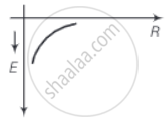
The graph for total energy versus orbital radius R is shown in the figure.
APPEARS IN
RELATED QUESTIONS
Suppose there existed a planet that went around the sun twice as fast as the earth.What would be its orbital size as compared to that of the earth?
The time period of an earth-satellite in circular orbit is independent of
A satellite is orbiting the earth close to its surface. A particle is to be projected from the satellite to just escape from the earth. The escape speed from the earth is ve. Its speed with respect to the satellite
Two satellites A and B move round the earth in the same orbit. The mass of B is twice the mass of A.
A body stretches a spring by a particular length at the earth's surface at the equator. At what height above the south pole will it stretch the same spring by the same length? Assume the earth to be spherical.
The radius of a planet is R1 and a satellite revolves round it in a circle of radius R2. The time period of revolution is T. Find the acceleration due to the gravitation of the planet at its surface.
Choose the correct option.
The binding energy of a satellite revolving around the planet in a circular orbit is 3 × 10⁹ J. It's kinetic energy is ______.
Answer the following question.
What do you mean by geostationary satellite?
Answer the following question in detail.
State any four applications of a communication satellite.
Answer the following question in detail.
What is a critical velocity?
Solve the following problem.
Calculate the speed of a satellite in an orbit at a height of 1000 km from the Earth’s surface.
(ME = 5.98 × 1024 kg, R = 6.4 × 10⁶ m)
Solve the following problem.
Calculate the value of acceleration due to gravity on the surface of Mars if the radius of Mars = 3.4 × 10³ km and its mass is 6.4 × 10²³ kg.
There is no atmosphere on moon because ____________.
What is the minimum energy required to launch a satellite of mass 'm' from the surface of the earth of mass 'M' and radius 'R' at an altitude 2R?
An aircraft is moving with uniform velocity 150 m/s in the space. If all the forces acting on it are balanced, then it will ______.
Two satellites of masses m1 and m2 (m1 > m2) are revolving round the earth in circular orbit of radii r1 and r2 (r1 > r2) respectively. Which of the following statements is true regarding their speeds v1 and v2?
A geostationary satellite is orbiting the earth at the height of 6R above the surface of earth. R being radius of earth. The time period of another satellite at a height of 2.5 R from the surface of earth is ____________.
Assuming that the earth is revolving around the sun in circular orbit of radius 'R', the angular momentum is directly proportional to rn. The value of 'n' is ______.
If a body weighing 40 kg-wt is taken inside the earth to a depth to `1/2` th radius of the earth, then the weight of the body at that point is ____________.
Two satellites are orbiting around the earth in circular orbits of same radius. One of them is 10 times greater in mass than the other. Their period of revolutions are in the ratio ______.
