Advertisements
Advertisements
प्रश्न
Show the nature of the following graph for a satellite orbiting the earth.
- KE vs orbital radius R
- PE vs orbital radius R
- TE vs orbital radius R.
Advertisements
उत्तर
Consider the diagram, where a satellite of mass m, moves around the earth in a circular orbit of radius R.

The orbital speed of the satellite orbiting the earth is given by `v_0 = sqrt((GM)/R)` where M and R are the mass and radius of the earth.
a. ∴ KE of a satellite of mass m,
= `1/2 mv_0^2 `
= `1/2m xx (GM)/R`
∴ `E_k ∝ 1/R`

It means the KE decrease exponentially with radius. The graph for KE versus orbital radius R is shown in figure.
b. Potential energy of a satellite `E-p = - (GMn)/R`
`E_p ∝ 1/R`
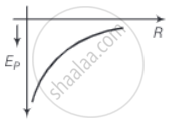
The graph for PE versus orbital radius R is shown in figure.
c. Total energy of the satellite `E = E_k + E_p`
= `(Gmm)/(2R) - (GMm)/R`
= `- (GMm)/(2R)`
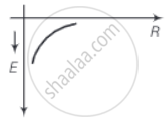
The graph for total energy versus orbital radius R is shown in the figure.
APPEARS IN
संबंधित प्रश्न
Suppose there existed a planet that went around the sun twice as fast as the earth.What would be its orbital size as compared to that of the earth?
The time period of an earth-satellite in circular orbit is independent of
A Mars satellite moving in an orbit of radius 9.4 × 10³ km takes 27540 s to complete one revolution. Calculate the mass of Mars.
Draw a labelled diagram to show different trajectories of a satellite depending upon the tangential projection speed.
Calculate the kinetic energy, potential energy, total energy and binding energy of an artificial satellite of mass 2000 kg orbiting at a height of 3600 km above the surface of the Earth.
Given: G = 6.67 × 10⁻¹¹ Nm2/kg2
R = 6400 km, M = 6 × 1024 kg
Answer the following question in detail.
Two satellites A and B are revolving round a planet. Their periods of revolution are 1 hour and 8 hour respectively. The radius of orbit of satellite B is 4 × 10⁴ km. Find radius of orbit of satellite A.
Solve the following problem.
Calculate the speed of a satellite in an orbit at a height of 1000 km from the Earth’s surface.
(ME = 5.98 × 1024 kg, R = 6.4 × 10⁶ m)
Solve the following problem.
Calculate the value of the universal gravitational constant from the given data. Mass of the Earth = 6 × 1024 kg, Radius of the Earth = 6400 km, and the acceleration due to gravity on the surface = 9.8 m/s2.
The kinetic energy of a revolving satellite (mass m) at a height equal to thrice the radius of the earth (R) is ______.
A geostationary satellite is orbiting the earth at the height of 6R above the surface of earth. R being radius of earth. The time period of another satellite at a height of 2.5 R from the surface of earth is ____________.
Assuming that the earth is revolving around the sun in circular orbit of radius 'R', the angular momentum is directly proportional to rn. The value of 'n' is ______.
A satellite of mass 'm', revolving round the earth of radius 'r' has kinetic energy (E). Its angular momentum is ______.
A satellite of mass 'm' is revolving around the earth of mass 'M' in an orbit of radius 'r' with constant angular velocity 'ω'. The angular momentum of the satellite is ______.
(G =gravitational constant)
In the case of earth, mean radius is 'R', acceleration due to gravity on the surface is 'g', angular speed about its own axis is 'ω'. What will be the radius of the orbit of a geostationary satellite?
A geostationary satellite is orbiting the earth at a height 6R above the surface of the earth, where R is the radius of the earth. This time period of another satellite at a height (2.5 R) from the surface of the earth is ______.
A satellite is revolving around a planet in a circular orbit close to its surface and ρ is the mean density and R is the radius of the planet, then the period of ______.
(G = universal constant of gravitation)
What is the typical altitude range for a polar satellite's orbit?
