Advertisements
Advertisements
प्रश्न
Is it possibe for a body to have inertia but no weight?
Advertisements
उत्तर
The weight of a body is the force with which it is attracted towards the centre of earth. When a body is stationary with respect to the earth, its weight equals gravity. This weight of the body is known as its static or true weight.
Inertia is a property of mass. Hence, a body can have inertia (i.e., mass) but no weight. Everybody always has inertia but its weight (mg) can be zero when it is taken at the centre of the earth or during free fall under gravity or a body placed at a very large distance from the earth. Basically, the weight of a body can be zero when acceleration due to gravity is zero, that condition is called weightlessness.
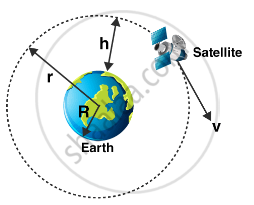
For example, When a satellite revolves in its orbit around the earth: Weightlessness possess many serious problems for astronauts. It becomes quite difficult for them to control their movements. Everything in the satellite has to be kept tied down. They can be displaced due to their inertia. The creation of artificial gravity is the answer to this problem
APPEARS IN
संबंधित प्रश्न
Two satellites going in equatorial plane have almost same radii. As seen from the earth one moves from east one to west and the other from west to east. Will they have the same time period as seen from the earth? If not which one will have less time period?
A satellite of mass 1000 kg is supposed to orbit the earth at a height of 2000 km above the earth's surface. Find (a) its speed in the orbit, (b) is kinetic energy, (c) the potential energy of the earth-satellite system and (d) its time period. Mass of the earth = 6 × 1024kg.
What is the true weight of an object in a geostationary satellite that weighed exactly 10.0 N at the north pole?
Find the minimum colatitude which can directly receive a signal from a geostationary satellite.
Answer the following question in detail.
State any four applications of a communication satellite.
Derive an expression for the binding energy of a body at rest on the Earth’s surface of a satellite.
Describe how an artificial satellite using a two-stage rocket is launched in an orbit around the Earth.
Calculate the kinetic energy, potential energy, total energy and binding energy of an artificial satellite of mass 2000 kg orbiting at a height of 3600 km above the surface of the Earth.
Given: G = 6.67 × 10⁻¹¹ Nm2/kg2
R = 6400 km, M = 6 × 1024 kg
Two satellites of a planet have periods of 32 days and 256 days. If the radius of the orbit of the former is R, the orbital radius of the Latter is ______
Which of the following statements is CORRECT in respect of a geostationary satellite?
What is the minimum energy required to launch a satellite of mass 'm' from the surface of the earth of mass 'M' and radius 'R' at an altitude 2R?
An aircraft is moving with uniform velocity 150 m/s in the space. If all the forces acting on it are balanced, then it will ______.
Reason of weightlessness in a satellite is ____________.
Two satellites of masses m and 4m orbit the earth in circular orbits of radii 8r and r respectively. The ratio of their orbital speeds is ____________.
If a body weighing 40 kg-wt is taken inside the earth to a depth to `1/2` th radius of the earth, then the weight of the body at that point is ____________.
A satellite is to revolve round the earth in a circle of radius 9600 km. The speed with which this satellite be projected into an orbit, will be ______.
A geostationary satellite is orbiting the earth at a height 6R above the surface of the earth, where R is the radius of the earth. This time period of another satellite at a height (2.5 R) from the surface of the earth is ______.
