Advertisements
Advertisements
प्रश्न
Show the nature of the following graph for a satellite orbiting the earth.
- KE vs orbital radius R
- PE vs orbital radius R
- TE vs orbital radius R.
Advertisements
उत्तर
Consider the diagram, where a satellite of mass m, moves around the earth in a circular orbit of radius R.

The orbital speed of the satellite orbiting the earth is given by `v_0 = sqrt((GM)/R)` where M and R are the mass and radius of the earth.
a. ∴ KE of a satellite of mass m,
= `1/2 mv_0^2 `
= `1/2m xx (GM)/R`
∴ `E_k ∝ 1/R`

It means the KE decrease exponentially with radius. The graph for KE versus orbital radius R is shown in figure.
b. Potential energy of a satellite `E-p = - (GMn)/R`
`E_p ∝ 1/R`
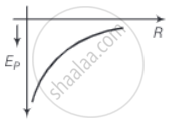
The graph for PE versus orbital radius R is shown in figure.
c. Total energy of the satellite `E = E_k + E_p`
= `(Gmm)/(2R) - (GMm)/R`
= `- (GMm)/(2R)`
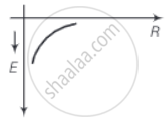
The graph for total energy versus orbital radius R is shown in the figure.
APPEARS IN
संबंधित प्रश्न
Suppose there existed a planet that went around the sun twice as fast as the earth.What would be its orbital size as compared to that of the earth?
Is it necessary for the plane of the orbit of a satellite to pass through the centre of the earth?
Consider earth satellites in circular orbits. A geostationary satellite must be at a height of about 36000 km from the earth's surface. Will any satellite moving at this height be a geostationary satellite? Will any satellite moving at this height have a time period of 24 hours?
Two satellites A and B move round the earth in the same orbit. The mass of B is twice the mass of A.
A pendulum having a bob of mass m is hanging in a ship sailing along the equator from east to west. When the ship is stationary with respect to water the tension in the string is T0. (a) Find the speed of the ship due to rotation of the earth about its axis. (b) Find the difference between T0 and the earth's attraction on the bob. (c) If the ship sails at speed v, what is the tension in the string? Angular speed of earth's rotation is ω and radius of the earth is R.
Choose the correct option.
The binding energy of a satellite revolving around the planet in a circular orbit is 3 × 10⁹ J. It's kinetic energy is ______.
Answer the following question.
Define the binding energy of a satellite.
Solve the following problem.
Calculate the speed of a satellite in an orbit at a height of 1000 km from the Earth’s surface.
(ME = 5.98 × 1024 kg, R = 6.4 × 10⁶ m)
There is no atmosphere on moon because ____________.
If a body weighing 40 kg is taken inside the earth to a depth to radius of the earth, then `1/8`th the weight of the body at that point is ______.
Out of following, the only correct statement about satellites is ____________.
A satellite is revolving in a circular orbit around the earth has total energy 'E'. Its potential energy in that orbit is ______.
A satellite is revolving in a circular orbit at a height 'h' above the surface of the earth of radius 'R'. The speed of the satellite in its orbit is one-fourth the escape velocity from the surface of the earth. The relation between 'h' and 'R' is ______.
The ratio of binding energy of a satellite at rest on earth's surface to the binding energy of a satellite of same mass revolving around the earth at a height h above the earth's surface is ______ (R = radius of the earth).
A satellite is revolving around a planet in a circular orbit close to its surface and ρ is the mean density and R is the radius of the planet, then the period of ______.
(G = universal constant of gravitation)
Artificial satellites are launched for all the following purposes EXCEPT ______.
Which application is mainly associated with polar satellites?
A satellite is revolving round the earth with orbital speed ‘V0’. If it stops suddenly, the speed with which it will strike the surface of the earth would be: (V = escape velocity of a particle on earth’s surface)
