Advertisements
Advertisements
प्रश्न
Observe the figure and answer the questions:

- State Newton's universal law of gravitation.
- If the distance between the two bodies is tripled, how will the gravitational force between them change?
- What will happen to gravitational force, if mass of one of the object is doubled?
Advertisements
उत्तर
- According to Newton’s universal law of gravitation theory, every object in the universe attracts every other object with a definite force. This force is directly proportional to the product of the masses of the two objects and is inversely proportional to the square of the distance between them. The above figure shows two objects with masses m1 and m2 kept at a distance d from each other. Mathematically, the gravitational force of attraction between these two bodies can be written as
`Fα (m_1m_2)/d^2 or F= G (m_1m_2)/d^2`
Here, G is the constant of proportionality and is called the universal gravitational constant. - If the distance between the two bodies is tripled, the gravitational force between them would decrease by a factor of 9 (since force is inversely proportional to the square of the distance). This is because according to the law of gravitation, F ∝ `1/d^2`, so if d becomes 3d, then
`F = G(m_1m_2)/(3d^2) = G(m_1m_2)/(9d^2)` - If the mass of one of the objects is doubled, the gravitational force between them will also double. This is because the force is directly proportional to the masses of the objects. So, F ∝ m1 or F ∝ m2, which means if m1 becomes 2m1,
`F = G(2m_1m_2)/(d^2) = 2G(m_1m_2)/(d^2)`
APPEARS IN
संबंधित प्रश्न
What happens to the force between two objects, if the masses of both objects are doubled?
Answer the following:
An astronaut inside a small space ship orbiting around the earth cannot detect gravity. If the space station orbiting around the earth has a large size, can he hope to detect gravity?
Choose the correct alternative:
Acceleration due to gravity increases/decreases with increasing altitude.
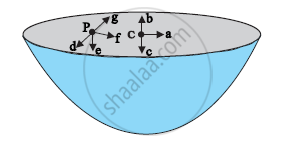
The gravitational intensity at the centre of a hemispherical shell of uniform mass density has the direction indicated by the arrow (see Fig 8.12) (i) a, (ii) b, (iii) c, (iv) 0.
A rocket is fired from the earth towards the sun. At what distance from the earth’s centre is the gravitational force on the rocket zero? Mass of the sun = 2 ×1030 kg, mass of the earth = 6 × 1024 kg. Neglect the effect of other planets etc. (orbital radius = 1.5 × 10¹¹ m).
State two applications of universal law of gravitation.
Suppose the gravitational potential due to a small system is k/r2 at a distance r from it. What will be the gravitational field? Can you think of any such system? What happens if there were negative masses?
Let V and E be the gravitational potential and gravitational field at a distance r from the centre of a uniform spherical shell. Consider the following two statements :
(A) The plot of V against r is discontinuous.
(B) The plot of E against r is discontinuous.
Two concentric spherical shells have masses M1, M2 and radii R1, R2 (R1 < R2). What is the force exerted by this system on a particle of mass m1 if it is placed at a distance (R1+ R2)/2 from the centre?
A ball is thrown vertically upwards. It goes to a height 20 m and then returns to the ground. Taking acceleration due to gravity g to be 10 ms-2 , find :
the total time of journey of the ball .
How will the force of gravitation between two objects change if the distance between them is:
Almost zero
All objects in the universe attract each other along the line joining their________.
What is the difference between gravity and gravitation?
Gravity is another kind of ________. It exerts all through the ________. The Sun's gravity keeps the ___________ in their orbits. Gravity can only be felt with very large ________.
Does the force of the earth's gravitation affect the motion of the moon? Explain your answer with reasons.
Show that gravity decreases at higher altitudes.
Three uniform spheres, each having mass m and radius r, are kept in such a way that each touches the other two. The magnitude of the gravitational force on any sphere due to the other two is
Choose the wrong option.
The gravitational force between a hollow spherical shell (of radius R and uniform density) and a point mass is F. Show the nature of F vs r graph where r is the distance of the point from the centre of the hollow spherical shell of uniform density.
A hollow spherical shell of uniform density exerts what gravitational force on a point mass placed inside it?
